Maisan Mountain
Maisan Mountain
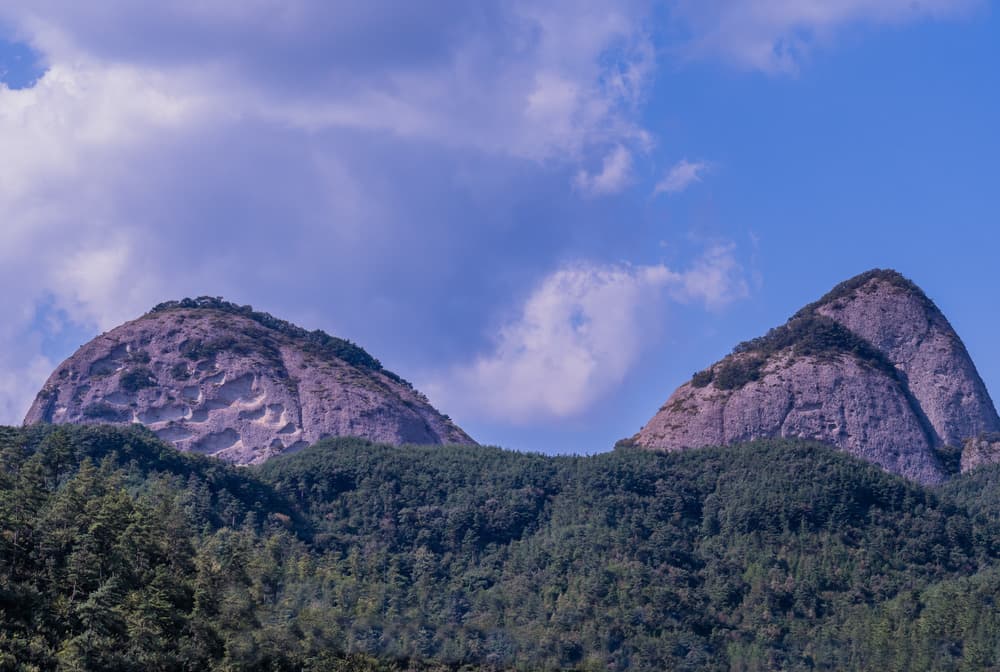
Near Jinan, Maisan Mountain rises with its twin peaks evoking horse ears, towering above Tapsa Temple and its stone pagodas.
Located near the city of Jinan in North Jeolla Province, Maisan Mountain derives its name from its two peaks that evoke the pricked ears of a horse. In Korean, Maisan indeed means "mountain of the horse's ear." Between these two summits stands Tapsa Temple, celebrated for its ensemble of stone pagodas erected in the late 19th century by a hermit monk. Integrated into Maisan Provincial Park, the site combines geological interest, Buddhist heritage, and hikes accessible to all levels.
Why visit Maisan Mountain
Maisan Mountain stands out through three complementary assets. First, its singular silhouette: twin peaks that surge above the surrounding plateau, one reaching approximately 685 metres (the eastern peak, nicknamed "the woman"), the other slightly lower (the western peak, "the man"). Next, Tapsa Temple and its pagodas, a unique ensemble in South Korea for its mortar-free construction technique. Finally, a pleasant provincial park to explore in all seasons, punctuated by a 3-kilometre cherry blossom tunnel particularly appreciated in spring.
History and legend
A local legend is associated with the birth of the two summits. Two fairies, a husband and wife, lived at this place. When their creator ordered them to return to heaven, they had to do so away from human sight. Choosing to depart at dawn after a cloudy night, they were spotted by an early-rising villager and immediately transformed into stone, falling to earth in the form of the two current peaks. According to local tradition, the eastern peak, the higher one, corresponds to the woman, and the western peak to the husband.
Between the two summits lies Tapsa Temple, whose pagodas are the work of hermit monk Lee Kap-yong. Construction began in 1885 and lasted more than thirty years. Originally, there were approximately 130 pagodas; around eighty remain today. Built without mortar, some exceed ten metres in height and have resisted for over a century the violent winds that sweep through the valley. While most of the stones come from the immediate surroundings, some were reportedly brought from reputed mountains in other regions of South Korea.
Nearby stands another less-visited sanctuary, Eunsusa Temple. Tradition recounts that King Taejo, founder of the Joseon dynasty, stayed there for a hundred days to pray during his journey to Mount Seongsusan.
What to see and do
Tapsa Temple and its pagodas
This is the main attraction of the site. The alignment of conical pagodas, standing among rocks and temple buildings, creates a landscape with no equivalent in the country. Take time to observe the variations in size, stone, and arrangement.
The eastern peak and western peak
The hike to the eastern peak (Amaibong, "the woman") is the most popular: marked trail, accessible to a hiker in good condition. The western peak (Sumaibong, "the man") requires climbing and remains more secluded.
Maisan Provincial Park
The park offers several hiking trails for full-day or half-day excursions. The cherry blossom tunnel, roughly 3 kilometres long, crosses the park and constitutes one of the most photographed itineraries at blossom time.
When to visit
Maisan Mountain welcomes visitors year-round, and Koreans give it four seasonal names that well summarise its appearance changes:
- Spring – Dotdaebong ("mast peaks"): morning mist makes the summits resemble a ship's masts. It is also the season for blooming cherry blossoms.
- Summer – Yonggakbong ("dragon horns"): dense green forests evoke a dragon whose peaks are the horns.
- Autumn – Maibong ("horse ears"): golden light and russet foliage accentuate the equine resemblance.
- Winter – Munpilbong ("ink brushes"): snow-covered, the peaks recall brushes dipped in black ink.
Spring (April–May) and autumn (October–November) remain the most pleasant periods for hiking and photography.
Practical information
The site is open year-round during daylight hours. Access hours are slightly reduced in winter. A modest entrance fee is charged at the park entrance, plus a parking fee if you arrive by car. Amounts remain low by Korean tourism standards.
Allow half a day for the classic loop Tapsa + eastern peak, and a full day if you wish to combine hiking, a visit to Eunsusa Temple, and leisurely exploration of the park.
How to get there
The logical starting point is the city of Jinan, connected by bus to Jeonju, the provincial capital. The Jeonju–Jinan journey takes approximately 50 minutes, with frequent departures throughout the day from the intercity bus terminal. From Jinan, local shuttles reach the park entrance in about ten minutes, at regular intervals.
By car, allow approximately 45 minutes from Jeonju via provincial roads. Parking is provided near the southern access, closest to Tapsa Temple.
In the surrounding area
The North Jeolla region holds several complementary sites. Jeonju, less than an hour away, is renowned for its traditional hanok quarter and gastronomy (birthplace of bibimbap). More broadly, South Korea has other major Buddhist ensembles accessible as part of the same circuit, such as Haeinsa Temple and its Tripitaka Koreana tablets, Magoksa Temple in Chungcheong, or Naksansa Temple by the east coast. In Seoul, Jongmyo Shrine complements well the historical dimension of a journey.
Frequently asked questions
Frequently asked questions
Maisan means "mountain of the horse's ear" in Korean, referring to the silhouette of its twin peaks. The mountain also bears four other names according to the seasons.
Around 80 are counted today, from the original 130. They were erected from 1885 by hermit monk Lee Kap-yong, and built without mortar.
Two main trails serve the mountain, one on the southern slope, the other on the northern slope. The southern slope is the most frequented as it provides direct access to Tapsa Temple and the eastern peak.
Spring, for the blossoming of the cherry trees in the 3 km tunnel, and autumn, for the colours of the foliage, are the two most appreciated seasons. Winter offers snow-covered landscapes that are very photogenic.
Intercity buses connect Jeonju to Jinan in approximately 50 minutes, at high frequency. From Jinan, a local shuttle serves the park entrance in about ten minutes.
Planning your trip
Maisan Mountain fits perfectly into an itinerary in the southwest of the peninsula, between Jeonju, Damyang, and Gwangju. To build a complete stay combining Buddhist heritage, traditional villages, and grand landscapes, consult our suggestions for travel in South Korea.
Nearby
Interested in this visit?
We can include it in your personalised itinerary.