Practical information South Korea
Preparing a trip to South Korea requires few heavy formalities but some precise guidelines. From Seoul, Maud and our English-speaking team answer the same questions daily: do you need a K-ETA to enter Incheon, what daily budget to expect in wons, how much does a KTX train from Seoul to Busan cost (around 60,000 wons in 2h15), where to use your T-money card on buses and subways. We also detail the climate season by season, as South Korea experiences four distinct seasons: cherry blossoms in late March in Jeju, monsoon from late June to mid-July, maple trees in October in Naejangsan, snow in January on Seoraksan. On health, no vaccine is required, tap water is drinkable and Seoul's international hospitals are excellent. Budget-wise, expect 90 to 140 euros per day per person in mid-range comfort, excluding international flights. We also cover etiquette (greet by bowing, remove shoes in a hanok, don't plant chopsticks vertically in rice), connectivity (Wi-Fi everywhere, eSIM recommended), payments (credit card accepted almost everywhere, cash useful at markets). Our pages finally detail security, which is very good, and the few precautions to know about the northern border and August-September typhoons.
Plan your trip by theme
Explore our practical guides organized by category to quickly find the information you need.

Before You Go
Passport, online K-ETA authorization, travel insurance, steps to plan ahead before traveling to South Korea.
2 articles
Budget Money
South Korean won, exchange rates, daily budget range per person, credit cards, mobile payments and tipping customs.
1 article
Climate Season
Four distinct seasons, July monsoon, cherry blossoms in April, maple leaves in October, snow on the Eastern mountains.
1 article
Transports
KTX, urban metros, T-money card, domestic flights to Jeju, car rental, taxis and local apps.

Culture
Greetings, table etiquette, footwear, age hierarchy, temple customs and daily conduct.
10 articles
Useful Tips
High security, healthcare, drinking water, 220V electricity, eSIM and Wi-Fi, useful daily apps.
All practical guides
Search and filter among 14 articles
14 of 14 results
Frequently asked questions
The answers to the most frequently asked questions from our travellers.
French, Belgian, Swiss and Canadian nationals do not need a visa for a tourist stay of less than 90 days. However, the K-ETA electronic authorization is required to enter by air or sea. It can be requested online on the official website k-eta.go.kr, costs approximately 10,000 won (7 euros), remains valid for 3 years and is generally obtained within 72 hours. Note: since 2024, a temporary K-ETA exemption is regularly renewed for French travelers, but we recommend applying for it as a precaution. Your passport must be valid for at least 6 months after your return date.
No vaccines are mandatory to enter South Korea. However, we recommend being up to date with universal vaccines (DTP, MMR, hepatitis B) and considering hepatitis A for travelers who will eat frequently at street markets. There is currently neither malaria nor dengue on the territory, and Japanese encephalitis remains a very low risk, to be discussed with a doctor for long stays in rural areas during summer. Tap water is potable but many Koreans prefer filtered water. The hospital system is excellent, particularly in Seoul (Severance Hospital, Asan Medical Center).
Expect between 90 and 140 euros per day and per person in mid-range comfort, excluding international flights. A meal in a neighborhood canteen costs 8,000-12,000 won (6-9 euros), a fine dining dinner around 30,000 won. A night in a 3-star hotel in Seoul ranges between 80 and 120 euros, a traditional hanok in Jeonju around 90 euros. The KTX Seoul-Busan train costs approximately 60,000 won (42 euros) in second class. Entry to palaces and museums remains very affordable (3,000 to 5,000 won). For a luxury trip with a private English-speaking guide, expect rather 250 to 350 euros per day.
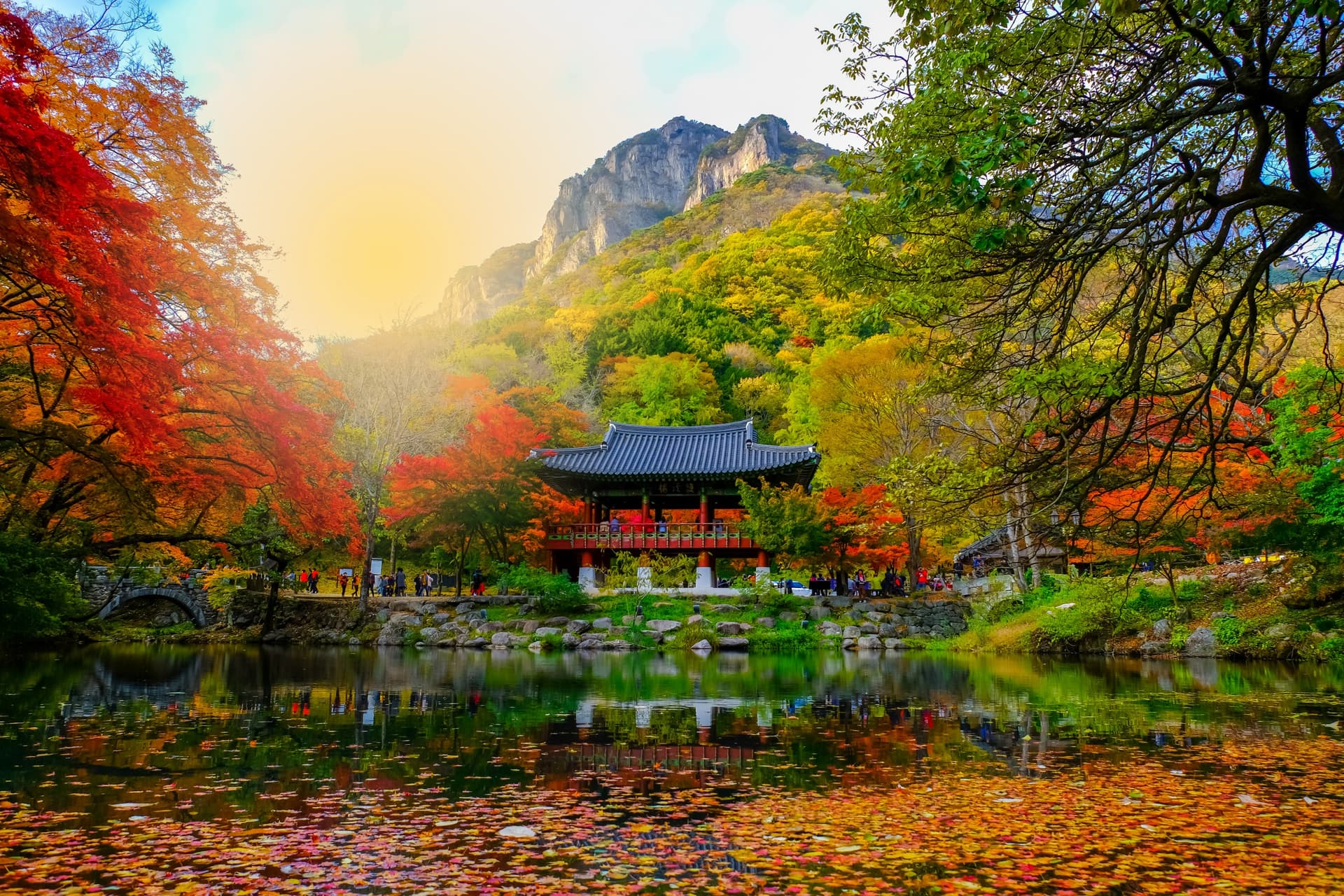
The two best periods are spring (mid-April to late May) for cherry blossoms, mild temperatures (15-22°C) and rice paddies turning green again, and autumn (mid-October to mid-November) for the blazing maples in national parks and very bright skies. Avoid the monsoon from late June to mid-July (heavy rains) and the humid heatwave in August (30-33°C with 80% humidity), often accompanied by typhoons on the southern coasts. Winter, from December to February, is dry and cold (-5 to 3°C in Seoul), ideal for ski enthusiasts in Gangwon or snowy landscapes at Seoraksan.
The railway network is the backbone of travel. The KTX (Korean high-speed train) connects Seoul to Busan in 2h15, to Gangneung in 2h and to Mokpo in 2h30. For medium-sized cities, long-distance express buses are comfortable and affordable. Within cities, metro and bus are accessed with the rechargeable T-money card (available at convenience stores). For Jeju, allow 1 hour flight time from Seoul-Gimpo, with dozens of daily rotations. Car rental is mainly worthwhile on Jeju or to explore villages in Jeolla, keeping in mind that not all signs are translated. The Kakao T (taxi) and Naver Map (the local Google Maps) apps are essential.
South Korea is among the safest countries in the world. Street crime is very low, you can walk at night in Seoul or Busan without particular concern, and it is common to leave your bag on a café table to reserve your seat. Precautions mainly concern typhoons in August-September on the south coast and Jeju, occasional demonstrations in Seoul (easy to avoid), and the demilitarized zone, which can only be visited with an authorized operator. Tensions with North Korea do not disrupt tourism. Our English-speaking team in Seoul remains available 24/7 during your stay.
Ready to travel to South Korea?
Discover our tailor-made itineraries, designed by our local team. Each route adapts to your pace, your preferences and your travel season.
See our toursWe use cookies to improve your experience and measure our site's audience. You can choose what you accept. Learn more.