Jongmyo Shrine
Jongmyo Shrine
A UNESCO World Heritage site, Jongmyo Shrine in Seoul houses the spiritual tablets of Joseon dynasty kings. The world's oldest preserved royal Confucian sanctuary.
Jongmyo Shrine, located in Seoul near the royal palaces, houses the spiritual tablets of the kings and queens of the Joseon dynasty. Inscribed as a UNESCO World Heritage site in 1995, it is recognized as the world's oldest preserved royal Confucian sanctuary. A visit illuminates a central chapter in the political and religious culture of pre-modern Korea.
Why visit Jongmyo Shrine
Jongmyo is neither a palace nor a Buddhist temple: it is a place of dynastic memory, designed for the worship of royal ancestors according to Confucian principles. The architecture is deliberately austere, without excessive ornamentation, setting it apart from other historical sites in Seoul.
Three main reasons to visit:
- A unique UNESCO site, recognized as the world's oldest preserved royal Confucian sanctuary.
- Remarkable architectural coherence: the main buildings date from 1601 and have been virtually unaltered since.
- The opportunity to witness, in May, the Jongmyo Jerye ceremony, designated a UNESCO Intangible Cultural Heritage.
History of the Shrine
Jongmyo Shrine was founded in 1394 by King Taejo, founder of the Joseon dynasty. The main building, the Jeongjeon, initially comprised seven chambers. This type of royal shrine was not a novelty in Korea: similar structures existed as far back as the Three Kingdoms period (57 B.C. – 668 A.D.) and served to house the spiritual tablets of ancestors.
During the reign of King Sejong (1418-1450), the complex was expanded with the construction of the Yeongnyeongjeon, a second ritual building designed to accommodate the tablets of ancestors and less central royal figures in official worship.
During the Seven Years' War (Japanese invasions in the late 16th century), the shrine was destroyed by fire. The spiritual tablets, considered the very soul of the dynasty, were saved at the last moment and hidden in a commoner's house. The site was reconstructed in 1601.
International and national recognition followed: inscription as a UNESCO World Heritage site in 1995, and designation as South Korea's National Treasure No. 227.
What to see on site
The Jeongjeon
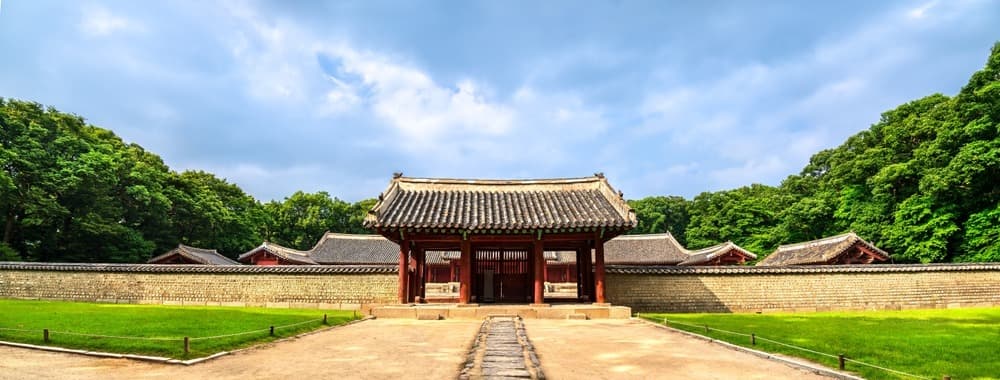
The central building of the shrine, the Jeongjeon is today subdivided into 19 chambers. Each houses the spiritual tablet of a Joseon dynasty king; some also hold the tablets of their queens, bringing the total to 49 tablets. The red walls and columns support a long tile roof that seems to float above the courtyard paved with rough stone. The sobriety and horizontality of the building express the Confucian spirit of the place.
The Yeongnyeongjeon
Neighboring the Jeongjeon, the Yeongnyeongjeon shares with it a common architectural language. It initially comprised 10 chambers; two were added in 1667, and a further expansion in 1836 brought the structure to 16 subdivisions. It houses 34 spiritual tablets dedicated to the ancestors of King Taejo across four generations, as well as posthumously crowned kings.
The Hyangdaecheong
Located near the south gate, this building once served as a storage facility for ritual utensils. Today it houses a replica of a spirit chamber: spiritual tablets in their wooden boxes, ritual books stored in a chest, and royal seals preserved in another. Examples of offerings used during ceremonies are also displayed here.
The Jaegung
Composed of three buildings surrounded by a wall, the Jaegung served as a waiting room for the king and his family before ceremonies. Its sparse appearance reflects a precise logic: here, rituals honor the ancestors, not the living king. The modesty of the place is therefore intentional.
When to go
The shrine is open year-round. Spring (April-May) and autumn (September-October) remain the most pleasant seasons, with mild weather and favorable light for photography.
The highlight of the year is the Jongmyo Jerye ceremony, traditionally held in May. Inscribed in UNESCO's Intangible Cultural Heritage list, it recreates Confucian rites honoring the Joseon kings, accompanied by ritual music known as Jongmyo Jeryeak. It is a rare opportunity to witness royal liturgy, centuries old, still practiced today.
Practical information
The site is open daily except Tuesdays. Hours vary slightly by season, with closing in early evening. Entry fees are moderate, and a combined ticket (Royal Palace Pass) grants access to the shrine and several of Seoul's royal palaces at a discounted rate.
On weekdays, visits are conducted with an official guide (included with your ticket), with dedicated time slots in English. Weekends and certain holidays allow free-paced exploration at your own rhythm. Plan 1 to 1.5 hours for a complete visit.
How to get there
By metro
The shrine is just a few minutes' walk from Jongno-3-ga station. Take exit 11 if arriving on Line 1, or exit 8 if traveling on Lines 3 or 5.
By bus
Fifteen bus lines serve the Jongno 4-ga stop, just steps from the shrine's entrance.
Nearby attractions
The area concentrates several major Seoul sites. The royal palaces Gyeongbokgung and Changdeokgung (also a UNESCO site) are within easy reach, as is the Bukchon hanok village. A well-organized day can combine Jongmyo, a royal palace, and a stroll through the neighboring traditional streets.
To extend cultural exploration beyond Seoul, other religious and historical sites deserve a visit, notably Haeinsa Temple with its Tripitaka Koreana tablets, Magoksa Temple, or Naksansa Temple on the east coast.
Frequently asked questions
Frequently asked questions
A complete visit, including the guide, takes approximately 1 to 1.5 hours. Visitors with an interest in Confucian architecture and Joseon dynasty history may wish to spend a bit longer.
On weekdays, yes: access is through an official guided tour (included with your ticket), with time slots available in Korean, English, Japanese, and Chinese. On weekends and certain holidays, visits are self-guided.
A palace is a royal residence; Jongmyo is a shrine dedicated to the worship of royal ancestors. The architecture is deliberately austere and functional, lacking the ornate pavilions and gardens typical of Joseon palaces.
Yes. The ceremony takes place once a year in May and remains open to the public. It is designated a UNESCO Intangible Cultural Heritage and ranks among Korea's most important ritual events.
Main pathways are navigable, but some rough stone paving surfaces may be uncomfortable. Facilities exist at the main entrance; it is recommended to inquire on-site about adapted guided tours.
Plan your trip
Jongmyo Shrine fits naturally into a cultural itinerary in Seoul, complementing royal palaces and historic neighborhoods. To build a custom journey combining Confucian heritage, Buddhist temples, and natural landscapes, explore our South Korea travel suggestions.
Nearby
Interested in this visit?
We can include it in your personalised itinerary.