Suncheon Bay Wetland Reserve
Suncheon Bay Wetland Reserve
A Ramsar-listed wetland and UNESCO Biosphere Reserve, Suncheon Bay stretches its reedy marshes and mudflats along South Korea's southern coast. An intact natural site, particularly spectacular in autumn during bird migration season.
Suncheon Bay, along South Korea's southern coast, is home to one of East Asia's largest coastal wetlands. Its mudflats, towering reed beds, and sinuous waterways form an intact ecosystem that attracts thousands of white-naped cranes and Oriental storks each autumn. Designated a UNESCO Biosphere Reserve, the bay is the green heart of a city that has made ecology its identity.
Quick facts
- Entrance: paid admission (combined ticket with Suncheon Bay National Garden)
- Recommended duration: 2 to 3 hours for the main circuit
- Best time to visit: October–November for golden reeds and migratory birds
- What to wear: comfortable, closed-toe shoes recommended; wooden boardwalks can be slippery in damp conditions
- Accessibility: main boardwalks are wheelchair accessible; Yongsan Viewpoint requires climbing on foot
What to expect
The site centers on two main features: the mudflats at low tide, where wading birds probe the silt, and the Phragmites australis reed bed stretching for several kilometers. A network of wooden boardwalks winds through the reeds at water level. From above, Yongsan Viewpoint offers panoramic views of the bay and its meandering channels.
History and context
Suncheon long resisted the industrial development that transformed much of South Korea's coastline—a rare choice in the country. The bay was inscribed on the Ramsar List of internationally important wetlands in 2006, then recognized as a UNESCO Biosphere Reserve in 2018. The city hosted the International Garden Expo in 2013, which reinforced its reputation as the country's ecological capital.
Highlights of your visit
Boardwalks through the reed beds
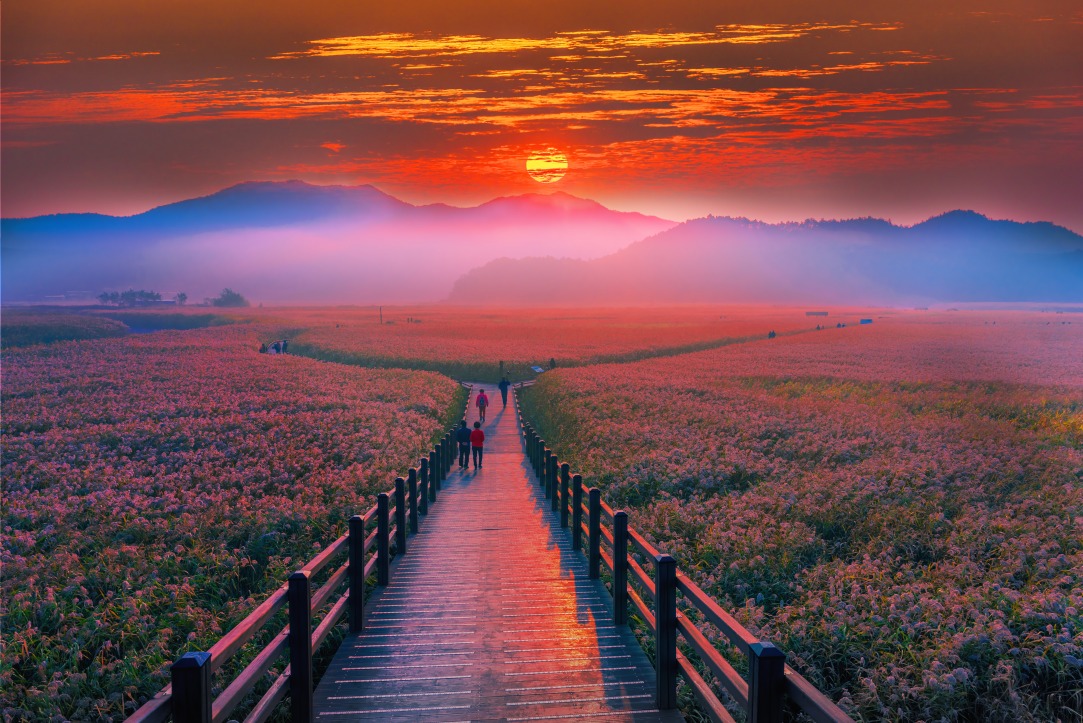
The main path winds through the marsh at water level. In autumn, the reeds tower several meters high and create a golden corridor. The only sounds are the wind and the calls of birds.
Yongsan Viewpoint
A short climb leads to this vantage point revealing the bay's full geography: channels, mudflats, and on clear days, distant islands. It's the classic angle from which to grasp the site's scale.
Migratory bird watching
Between October and March, white-naped cranes (Grus vipio), Oriental storks, and wild ducks winter in the bay. Discreet observation posts dot the trail. Binoculars are essential.
Photography tips
Golden late-afternoon light in October transforms the reeds into a sea of copper. From Yongsan Viewpoint, sunrise reveals the bay's channels through morning mist. Avoid midday sun in summer: the light is harsh and birds are absent. Drone use is regulated within the reserve.
Location and access
The reserve sits on the southern edge of Suncheon, a city in South Jeolla Province. From Suncheon Station (on the KTX line from Seoul), local buses serve the main entrance. The adjacent Suncheon Bay National Garden is covered by the same combined ticket.
Nearby attractions
- Suncheon Bay National Garden — themed international gardens created for the 2013 Expo, connected to the reserve by a pedestrian tunnel.
- Songgwangsa Temple — one of South Korea's three great Buddhist temples, nestled in the Jogyesan mountains about 30 kilometers north.
- Naganeupseong Fortified Village — a traditional Korean village still inhabited, surrounded by stone ramparts, roughly 20 kilometers away.
Interested in this visit?
We can include it in your personalised itinerary.