Dongdaemun Market
Dongdaemun Market
In Seoul, Dongdaemun Market brings together fashion towers, textile wholesalers, hanbok boutiques, street food and the Dongdaemun Design Plaza, in a district that stays open until dawn.
Also called Tongdaemun or DDM, Dongdaemun Market occupies the Jongno-gu district in central-east Seoul. This vast commercial complex blends traditional market, fashion towers and wholesale centers across an area designated a "special tourism zone" since 2002. Visitors come for textiles, hanbok, late-night street food and the energy of a district that never truly sleeps.
Why visit Dongdaemun Market
Dongdaemun is not a single market but an ecosystem of dozens of shopping malls, attached to older commercial arcades and a textile wholesale district. A few reasons to stop by:
- a rare concentration of fashion boutiques, from ready-to-wear to Korean designer pieces;
- one of the country's largest hanbok (traditional Korean garment) hubs, from vintage models to contemporary reinterpretations;
- dense late-night activity among wholesalers, with alleys that come alive when the rest of the city sleeps;
- a street food scene gathered around Mukja Golmok street and neighboring alleys;
- the presence of Dongdaemun Design Plaza (DDP), a building signed by Zaha Hadid, which reshaped the district.
Market History
The market opens in July 1905 in Yeji-dong, whose name literally means "district for learning courtesy." Originally located in a modest structure, it suffers considerable losses until the Korean War, which durably disrupts the district's commerce.
In 1959, the market is relocated in a more contemporary architecture and gradually regains its role as a textile and wholesale hub for the capital. By the late 1990s, in 1998-1999, several large modern commercial buildings rise, including Geopyeong Freya Tower, initiating the site's mutation toward a large-scale fashion complex. Classification as a "special tourism zone" in 2002, then the opening of Dongdaemun Design Plaza in 2014, complete the district's establishment in the international landscape.
What to See and Do
The complex divides into two main sections, separated by the avenue bordering Heunginjimun Gate.
The "tourist" section: fashion towers and shopping centers
On the west side, you'll find centers geared toward the general public, open in the evening and often until late at night:
- Doosan Tower, Migliore and Hello apM, three towers concentrating ready-to-wear, accessories and cosmetics;
- periodic fashion shows and events organized at the foot of the towers;
- currency exchange offices and information stands with English-speaking staff, helpful for navigating such an extensive site.
The wholesale section and DDP
On the east side, commerce is organized around textile wholesalers, who generally accept unit sales even though prices are geared for resale:
- Jeil Pyeonghwa and the historic Heunginmun sector, frequented by an older clientele;
- Designer's Club, Migliore Valley, Nuzzon and Gwanghee Fashion Mall, more oriented toward young buyers and resellers;
- the Dongdaemun Design Plaza (DDP), which hosts exhibitions, design fairs and designer boutiques;
- the Pyeonghwa Market, whose 1st floor houses a collection of rare and out-of-print books at accessible prices.
Hanbok and textiles
Dongdaemun is one of Korea's major hanbok centers, with boutiques covering both traditional and modernized versions. The neighboring textile sections supply much of the country's sewing workshops.
Street food and nightlife
For quick bites, Mukja Golmok street and the Saeseon-gui and Dakhanmari alleys line up counters serving chicken soup (dak hanmari), grilled fish and Korean fried snacks. The wholesale zone remains active much of the night, until the early morning hours.
Practical Information
- Duration of visit: plan for 2 to 4 hours for a focused exploration, half a day or more if you compare centers.
- Hours: highly variable depending on the centers. Fashion towers open in late morning and close in the middle of the night; most shops close on Mondays or public holidays.
- Services: nursing and rest rooms, bank, ATMs, 24/7 GS25 convenience store.
- Good to know: some boutiques have no fitting rooms, better to check the fit before buying. A map of the complex is useful, the site is very extensive.
- Payment: most centers accept cards; at wholesalers, bring cash.
When to Visit
Dongdaemun can be visited year-round, most activities being indoors. A few pointers to plan your visit:
- In the evening and at night: this is when the district comes fully into its own, with illuminated towers, street food and wholesale activity ramping up.
- Sale seasons: late summer and late winter concentrate clearance sales in shopping centers.
- Fashion weeks and DDP events: Seoul Fashion Week and Design Plaza exhibitions occasionally animate the site, check the official calendar.
- To avoid: Mondays, when many wholesale shops are closed.
How to Get There
The district is very well served by Seoul's public transportation.
- Metro: Lines 1 or 4, Dongdaemun station, exits 8 or 9. Dongdaemun History & Culture Park station (lines 2, 4, 5) serves the DDP more directly.
- Bus: stops at Jongno-6-ga, Cheonggye-6-ga and Dongdaemun Stadium (Dongdaemun-undongjang).
- Night bus: Seoul's night bus lines (Owl Bus / N-Bus) allow you to reach the market in the middle of the night, useful for taking advantage of the wholesale zone.
Nearby Attractions
Dongdaemun is part of a broader tour through Seoul and surroundings:
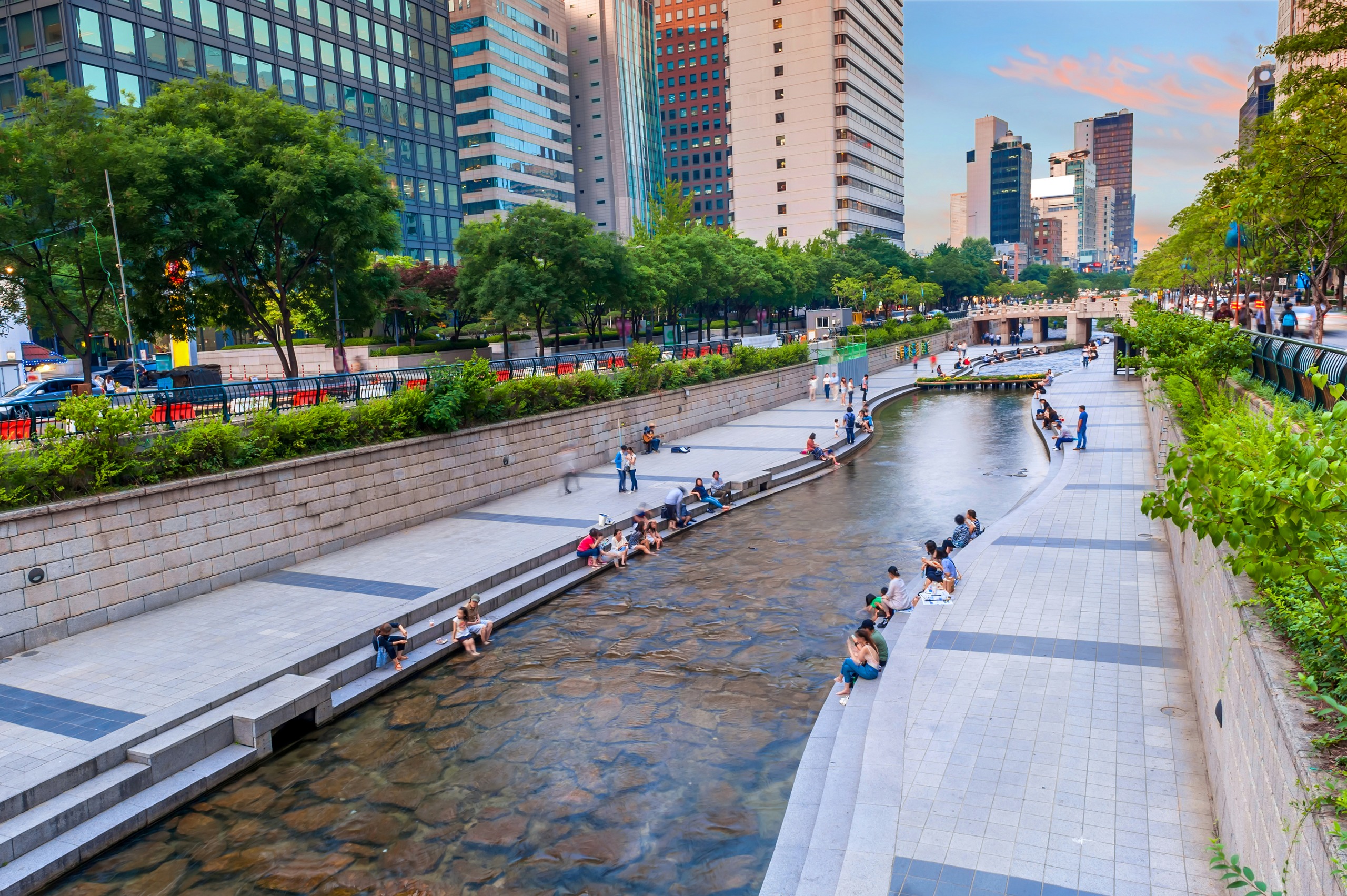
- the Cheonggyecheon promenade, whose eastern end borders the district;
- the Heunginjimun gate (Dongdaemun, "Great East Gate"), designated a national treasure, a few minutes' walk away;
- nearby markets Gwangjang (street food, hanbok) and Pyeonghwa;
- more broadly, other Seoul highlights: Gyeongbokgung Palace, Bukchon, Insadong.
To extend your trip beyond the capital, you can combine Dongdaemun with a beach stop at Haeundae Beach in Busan, or with major Buddhist sites such as Haeinsa Temple and Magoksa Temple.
Frequently Asked Questions
Frequently asked questions
Yes, largely so. Fashion towers close in the middle of the night and the wholesale zone operates until the early morning hours. A GS25 convenience store remains open 24/7 on site.
Dongdaemun refers to the entire commercial district. The DDP is a cultural and commercial building designed by Zaha Hadid, opened in 2014, occupying part of the wholesale zone and hosting exhibitions, design boutiques and events.
Often yes, even though prices and presentations are geared for resale. Better to compare with neighboring fashion towers, where retail sales are the norm.
The simplest way is by metro: lines 1 or 4, Dongdaemun station, exits 8 or 9. Dongdaemun History & Culture Park station (lines 2, 4, 5) is closer to the DDP.
Plan for 2 to 4 hours for a focused visit (one or two towers, the DDP, street food), half a day or more if you want to compare multiple centers or explore the wholesale section.
Include Dongdaemun in Your Trip
Dongdaemun integrates easily into a Seoul stay, complementing royal palaces and historic districts. To plan a custom itinerary incorporating the capital, its markets and the rest of the country, explore our South Korea travel ideas.
Nearby
Interested in this visit?
We can include it in your personalised itinerary.