War Memorial of Korea (Musée de la Guerre de Corée)
War Memorial of Korea (Musée de la Guerre de Corée)
The War Memorial of Korea spans two millennia of Korean military history, from antiquity through the Korean War. Free admission, open-air grounds with full-scale equipment, and immersive indoor galleries in Yongsan, Seoul.
The War Memorial of Korea stands in the Itaewon district of Yongsan. Opened in 1994, it traces Korean military history from antiquity through the Korean War (1950–1953) and beyond. With expansive indoor galleries and an esplanade lined with full-scale military equipment, it ranks among Seoul's most visited museums—and admission is free.
Practical Information at a Glance
- Admission: Free for permanent collections
- Closed: Mondays
- Recommended duration: 2 to 3 hours for main galleries; longer if exploring the outdoor esplanade
- Access: Subway lines 4 or 6, Samgakji Station (exits 11 or 12), a few minutes on foot
- Accessibility: Main building wheelchair accessible; elevators available
- Dress code: No restrictions
What You'll See
The museum divides into indoor spaces and a large outdoor esplanade. Inside, six permanent galleries cover the Wars of the Three Kingdoms, Japanese invasions of the late 16th century, the Korean War, and modern peacekeeping operations. Battle reconstructions, interactive maps, and period uniforms make the chronology accessible.
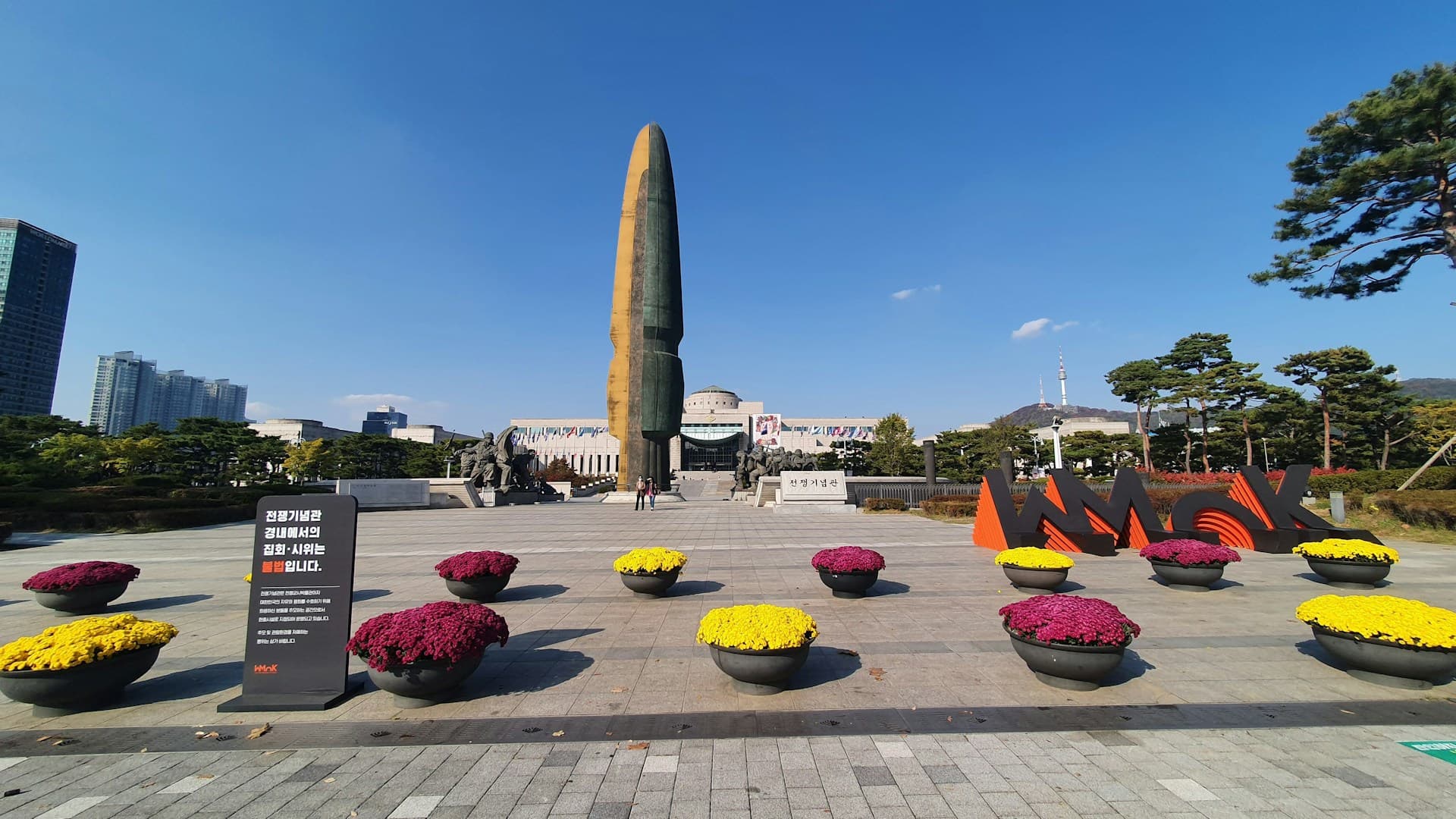
Outside, fighter jets, tanks, helicopters, missiles, and warships are displayed in the open air. Children can climb on certain equipment in a dedicated play zone.
History and Context
The site occupies the former headquarters of the Korean Army. The memorial was designed to honor soldiers killed during the Korean War, a conflict that claimed more than two million military and civilian lives. A long outdoor gallery inscribes the names of South Korean soldiers and United Nations forces who died in combat.
The Korean War technically remains unresolved: an armistice was signed in 1953, but no peace treaty has followed. This context gives the museum a resonance that extends far beyond simple historical narrative.
Highlights of Your Visit
The Korean War Hall
This is the museum's heart. Large-scale dioramas, authentic equipment, filmed testimonies, and detailed chronology reconstruct three years of conflict. The Incheon Landing and the Chosin Reservoir retreat are particularly well documented.
The Military Equipment Esplanade
More than a hundred pieces of ordnance—aircraft, captured North Korean T-34 tanks, ballistic missiles—are arranged in the open. Visitors roam freely and can view the vehicles up close.
The United Nations Wall
This long outdoor wall lists the names of soldiers from sixteen nations who died in Korea between 1950 and 1953. A spare, contemplative space, often less crowded than the indoor galleries.
The Ancient Military History Gallery
Armor, swords, bows, and fortification reconstructions span two millennia of Korean defense. A useful counterpoint for understanding the country's long military tradition before the twentieth century.
Photography Tips
The outdoor esplanade offers the best opportunities: natural light, grand scale, and varied angles around aircraft and tanks. Morning hours bring softer light and smaller crowds. Inside, photography is generally permitted in permanent galleries, but check signage in each room—some reconstruction areas may be restricted.
Location and Access
The museum sits in the Yongsan district, immediately adjacent to Itaewon. Samgakji Station (lines 4 and 6) is the closest metro stop. The Yongsan area also houses the N Seoul Tower, accessible from Itaewon. The museum is roughly twenty minutes by metro from the historic center at Gyeongbokgung Palace.
Nearby Attractions
- Itaewon — cosmopolitan neighborhood just steps away, known for international dining and nightlife.
- Gyeongbokgung Palace — the largest palace of the Joseon dynasty, north of downtown.
- N Seoul Tower — panoramic views of the capital from Namsan Mountain, accessible from Itaewon.
- Namdaemun Market — one of Seoul's largest traditional markets, a few metro stops away.
Frequently asked questions
Permanent collections are free. Temporary exhibitions may charge admission depending on the program.
The museum is closed on Mondays. Plan your visit for another weekday or the weekend.
Allow two to three hours for the main galleries. If you want to explore the outdoor esplanade thoroughly, set aside half a day.
Take the subway line 4 or 6 to Samgakji Station. Exits 11 and 12 lead directly to the museum in a few minutes on foot.
Yes, Itaewon is just a few minutes' walk away. A morning at the museum followed by lunch in Itaewon is a practical and popular combination.
The outdoor esplanade with its aircraft and tanks appeals greatly to children. A play zone allows them to interact with certain equipment. Indoor galleries are better suited to teenagers and adults.
Interested in this visit?
We can include it in your personalised itinerary.