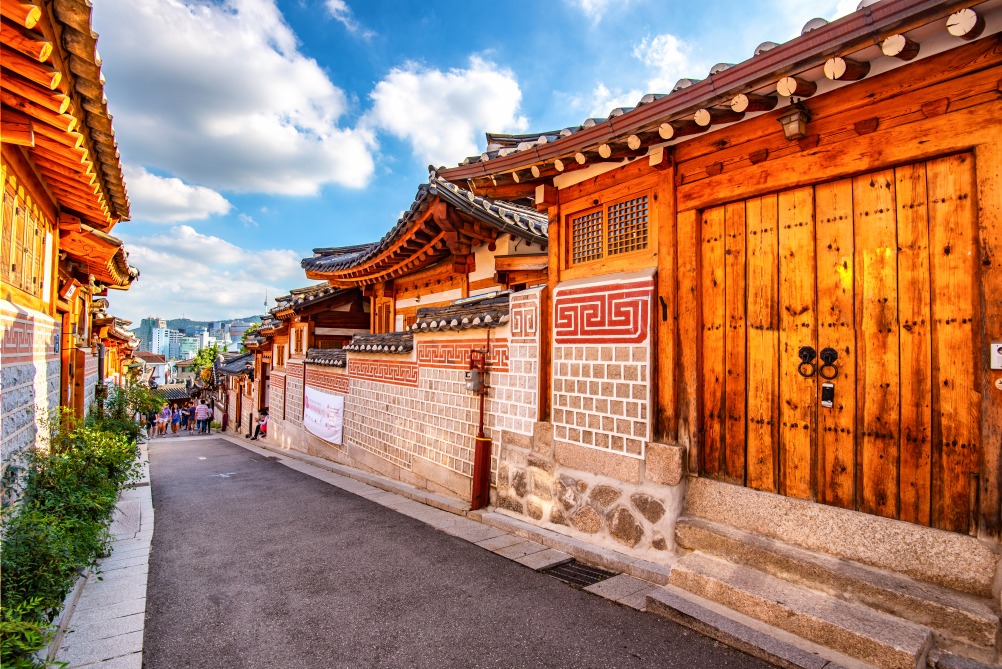
Hanok Namsangol Village
Hanok Namsangol Village
At the foot of Namsan in Seoul, this village-museum unites five 19th-century hanok, a traditional garden and hands-on workshops celebrating Joseon culture.
At the foot of Mount Namsan, in central Seoul, Hanok Namsangol Village brings together five traditional Korean homes dating from the second half of the 19th century. Opened in 1998 on 9,934 m², the site occupies the former Jeonghakdong location, a summer retreat prized during the Joseon era for the coolness of its springs and the quality of its setting.
Why visit Hanok Namsangol Village
The village offers an efficient way to understand the residential architecture of the Joseon dynasty without leaving central Seoul. Unlike a preserved historic district like Bukchon, this is a reconstructed ensemble: the hanok were dismantled from their original sites and reassembled at Namsangol, with the exception of the Yun-ssi house. This museum approach makes it possible to gather in one location dwellings of varying social status, from commoner homes to official residences.
The site's other appeal lies in its working workshops: hanbok try-ons, Hangul initiation, taekwondo demonstrations, tea tastings, traditional Korean medicine, straw basketry and folk games. A visit thus combines heritage architecture with hands-on experience, making it a instructive stop for a first introduction to Korean culture.
History of the site
The Jeonghakdong district, at the foot of Namsan, was among the most sought-after residential areas of the Joseon capital, notably for its streams and summer microclimate. When the Seoul municipality decided to create a village-museum there, it chose to relocate five representative hanok rather than build replicas. The opening took place in 1998.
Among the reassembled buildings, one is attributed to the master carpenter who participated in the restoration of Gyeongbokgung Palace in 1867. Another dwelling belonged to Yun Taek-yeong, father-in-law of Sunjong, the last emperor of Korea. This diversity of social origins — aristocracy, civil service, working classes — gives the village its pedagogical coherence.
What to see
The five hanok
Each house illustrates a distinct social status and preserves its original furnishings or faithful reconstructions. The volumes, ondol (heated floors), interior courtyards and room arrangement according to the rank of occupants can be read from one dwelling to the next.
Cheonugak Pavilion and Cheonghakji Pond
The traditional garden laid out at the village's creation includes a stream, Cheonugak Pavilion and Cheonghakji Pond, faithful to the Joseon landscaping spirit.
The Time Capsule
This architectural work was buried in 1994 to celebrate the 600th anniversary of Seoul as capital. It contains 600 objects representative of contemporary daily life and is scheduled to be opened in 2394.
Complementary spaces
- Center for traditional Korean music
- Dedicated crafts space
- Traditional park around the garden
Practical information
- Admission: free for the village. Some activities (hanbok rental, workshops) have separate fees.
- Duration of visit: allow 1 to 2 hours for a tour of the hanok and garden, longer if you participate in a workshop.
- Closure days: the site closes one day per week, typically early in the week. Check the official calendar before visiting.
- Hours: daytime opening, with extended hours in warm season and reduced hours in winter.
When to visit
The village can be visited year-round, but the garden takes on another dimension in spring with blooming flowers and in autumn when the maples turn color. In summer, the streams and shade of the hanok offer welcome respite from Seoul's heat. In winter, under snow, the curved roofs create a photogenic backdrop. Occasional events (traditional festivals, Chuseok, Lunar New Year) feature additional demonstrations: it's worth checking the program before your visit.
How to get there
The easiest way is by subway: Chungmuro Station, served by lines 3 and 4 of Seoul's subway system. Exit 3 or 4 leads directly to the village entrance in just a few minutes on foot. The site is located near Namsan and N Seoul Tower, making it easy to visit both in the same half-day.
Nearby
- N Seoul Tower: at the summit of Namsan, accessible by cable car or hiking trail, panoramic views of the capital.
- Myeongdong: shopping and dining district one subway stop away.
- Chungmuro: former Korean cinema district, pleasant to explore on foot.
- Bukchon Hanok Village: for comparison with a hanok district preserved in situ.
To extend your itinerary beyond Seoul, Hwaseong Fortress in Suwon makes a coherent historical complement.
Frequently asked questions
Frequently asked questions
Access to the village and its five hanok is free. Only certain specific activities (hanbok rental, craft workshops, tea ceremony) are charged separately.
Allow approximately 1 to 2 hours to tour the five hanok, garden, Cheonugak Pavilion and Time Capsule. Add 30 to 60 minutes if you participate in a workshop.
No, the village closes one day per week, typically early in the week. Opening hours are also longer from April to October than in winter. Check the official calendar before your visit.
Yes, dedicated spaces allow you to dress in traditional Korean attire and walk around the village. This activity is particularly popular for photos in the hanok setting.
The village is located at the foot of Mount Namsan. You can spend the morning at Hanok Namsangol Village, then head up to N Seoul Tower by cable car or on foot in the afternoon.
Include this visit in your trip
Hanok Namsangol Village fits naturally into a Seoul stopover centered on Joseon heritage, with royal palaces, Bukchon district and Mount Namsan. To build a customized itinerary, explore our trips to South Korea.

Interested in this visit?
We can include it in your personalised itinerary.