Deoksugung Palace
Deoksugung Palace
In the heart of Seoul, Deoksugung Palace blends Joseon pavilions with rare neoclassical buildings from the late 19th century. History, visit and practical access.
Deoksugung Palace occupies a historic island in the heart of Jung-gu district, in Seoul, where pavilions with curved roofs stand alongside neoclassical buildings rarely seen in South Korea. This architectural coexistence, inherited from the upheavals of the late 19th century, makes it one of the five great royal palaces of the capital.
Why visit Deoksugung Palace
Deoksugung stands apart from Seoul's other palaces through its hybrid character: alongside traditional wooden pavilions stand stone buildings designed by Western architects at the behest of King Kojong. The site thus combines the legacy of the Joseon Dynasty and that, shorter-lived, of the ephemeral Daehan Empire (1897-1910). Plan for approximately one hour to tour the grounds, longer if you intend to visit the museum housed in Seokjojeon or to attend the royal guard changing ceremony.
History of the palace
Also known as the "Palace of Virtuous Longevity," Deoksugung originally served as a residence for Prince Wolsan during the Joseon Dynasty. During the Japanese invasion of 1592, the building escaped the destruction that ravaged other capital palaces; King Seonjo took up residence there briefly the following year. After the coronations of Kings Gwanghaegun and Injo, the complex was renamed Gyeongungung, then abandoned for several decades.
In 1897, King Kojong had Western-style buildings erected there as part of the proclamation of the Daehan Empire. In 1907, his son Sunjong ascended to the throne within Deoksugung itself. During Japanese colonial rule (1910-1945), part of the complex was dismantled or sold, and the grounds transformed into a public park. Since 2007, a progressive restoration program has aimed to restore the palace to a configuration closer to its original state.
What to see within the grounds
The Daehanmun Gate and the changing of the guard
Access is through the main Daehanmun Gate, in front of which the royal guard changing ceremony takes place. The parade, in period costumes, occurs three times daily and lasts approximately thirty minutes. It is one of Seoul's most-watched historical reenactments.
Junghwamun and Junghwajeon
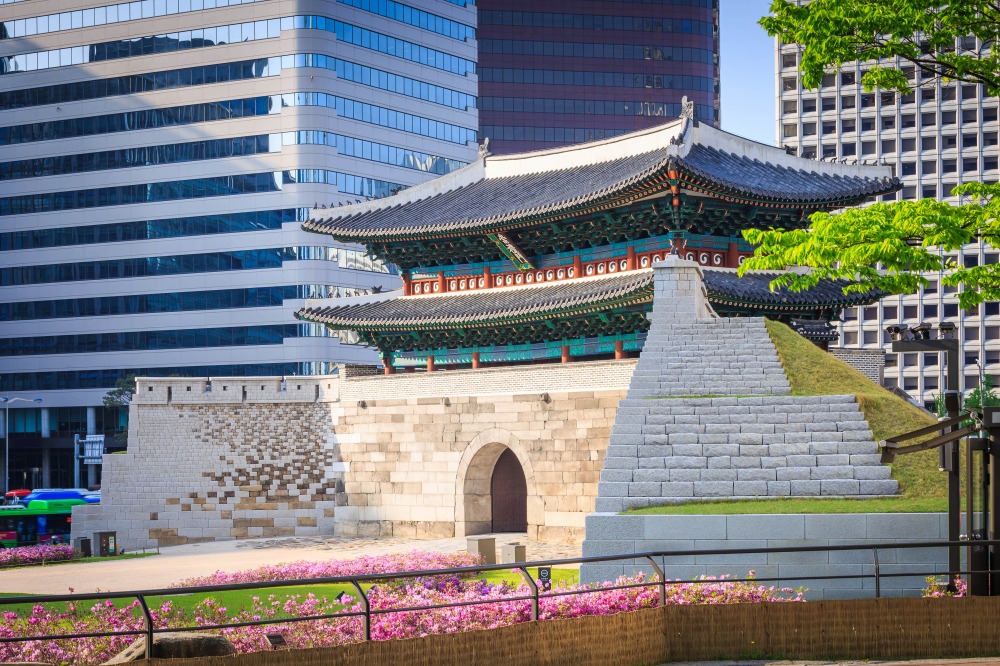
Beyond the second Junghwamun gate stands Junghwajeon, the palace's main building. Its framework combines Eastern and Western influences, and the royal throne is preserved in place. This is where official ceremonies took place. Behind the pavilion lies the passage King Kojong used during his escape to the Russian legation in 1896 — an episode often referenced as that of the "secret passages."
Seokeodang and Jeukjodang
The two-story Seokeodang is recognizable by its rough wooden framework, left without decorative covering. Just beside it, Jeukjodang houses the throne room used by Kings Gwanghaegun and Injo. Nearby, Jungmyeongjeon completes this ensemble of interconnected pavilions.
Seokjojeon, the neoclassical pavilion
A singular edifice within a Korean palace, Seokjojeon was designed by British architect John Reginald Harding in 1898. Transformed into a Museum of Daehan Empire History, it can be visited free of charge, by prior reservation. A Western-style garden, adorned with a fountain, extends from the building.
Gwangmyeongmun and technical collections
Beneath the former Hamnyeongjeon gate, the Gwangmyeongmun, are displayed a water clock, a bell, and a piece of Korean artillery, the Hwacha. These objects bear witness to the technical expertise of the Joseon period.
Practical information
- Duration of visit: approximately 1 hour, up to 2 hours with the Seokjojeon museum.
- Admission: paid entry at modest cost; free for the Museum of Daehan Empire History by prior reservation.
- Free guided tours in Korean, Chinese, Japanese and English-speaking groups. English-language tours are generally scheduled late morning and early afternoon, Tuesday to Sunday, outside school holidays.
- Closed day: Monday.
- Opening hours vary by season: check the current schedule on the official website before your visit.
When to visit
Deoksugung lends itself to visiting year-round, but two seasons stand out. Autumn (October-November) adorns the ginkgo trees lining the palace avenue with brilliant yellow, particularly photogenic. Spring (April-May) offers soft light and mild temperatures, ideal for strolling between pavilions. Summer is more humid, winter more rigorous but often sunny. To attend the guard changing ceremony, plan your visit around the three daily time slots, generally spread between late morning and mid-afternoon.
How to get there
The palace is easily accessible by subway:
- Line 1, City Hall station, exit 2.
- Line 2, City Hall station, exit 3.
The Daehanmun entrance is a few minutes' walk from the exit. Being in a central district, you can also reach it on foot from Gwanghwamun or Myeongdong in about twenty minutes.
Nearby
The palace is situated in a district dense with historical and cultural sites, conducive to a day of walking exploration. In Seoul, you will find other royal palaces such as Gyeongbokgung and Changdeokgung, as well as the restored Cheonggyecheon stream, within a few blocks. Should you extend your stay southward, several major sites merit a detour.
- Haeinsa Temple — guardian of the Tripitaka Koreana, in the Gaya Mountains.
- Magoksa Temple — Buddhist complex in the heart of a forested valley.
- Haeundae Beach — Busan's most well-known urban beach.
Frequently asked questions
Frequently asked questions
Plan for approximately 1 hour to tour the main pavilions, and up to 2 hours if you visit the Museum of Daehan Empire History housed in Seokjojeon.
Palace entry is charged at modest cost. A visit to the Seokjojeon museum is free but requires prior reservation.
The ceremony is held three times daily in front of the Daehanmun Gate and lasts approximately thirty minutes. It is generally suspended on Monday, the palace's closing day, and in case of inclement weather.
Free guided tours are offered in Korean, Chinese, Japanese and English. English-language tours are generally scheduled late morning and early afternoon, Tuesday to Sunday. English-speaking visitors can join an English-language group or use an audio guide.
Autumn, in October and November, is particularly appreciated for the golden ginkgo trees that line the palace. Spring remains equally pleasant thanks to mild temperatures.
Include Deoksugung in your itinerary
The palace fits naturally into a day devoted to Seoul's historic center, complementing the other royal palaces. To plan a custom-made stay including the capital and other regions of the country, consult our journeys in South Korea.
Nearby
Interested in this visit?
We can include it in your personalised itinerary.