Tumuli Park (Daereungwon)
Tumuli Park (Daereungwon)
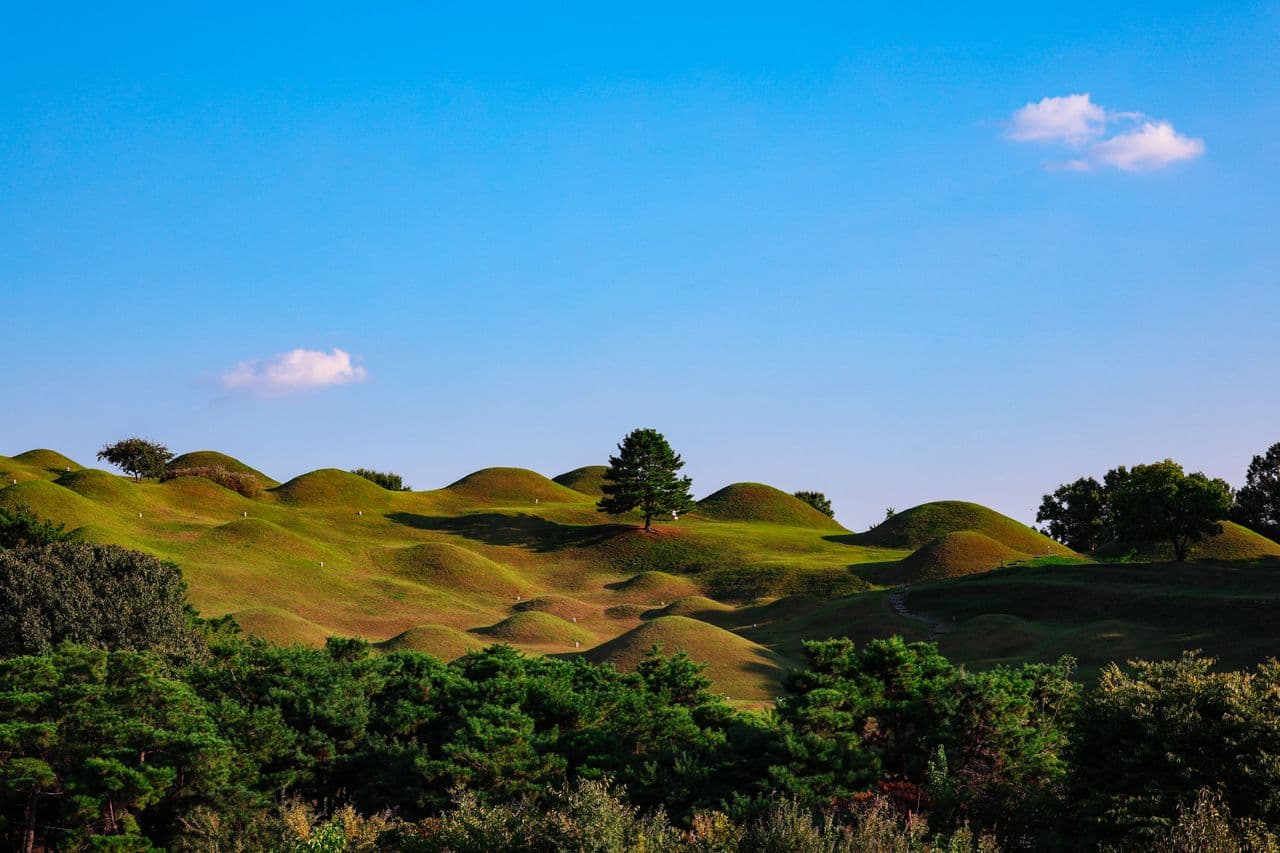
In the heart of Gyeongju, Tumuli Park brings together roughly twenty royal burial mounds from the Silla Kingdom (4th–6th centuries), inscribed as a UNESCO World Heritage Site. Only one mound, Cheonmachong, is open for interior exploration.
In the heart of Gyeongju, the former capital of the Silla Kingdom, Tumuli Park — officially known as Daereungwon — brings together roughly twenty grand royal burial mounds dating from the 4th to 6th centuries. These softly rounded, grass-covered hills conceal the sepulchers of Silla elites and their funerary treasures. The site, inscribed as a UNESCO World Heritage Site as part of Gyeongju's historic areas, offers a rare stroll where archaeology and landscape merge.
Practical Information at a Glance
- Admission: paid entry (reduced rates for children and seniors)
- Recommended duration: 1 to 1.5 hours
- Access: Hwangnam district, central Gyeongju — accessible on foot from the bus station or by local bus
- Dress code: no restrictions
- Accessibility: main pathways are paved and wheelchair-accessible
What You'll See
The park contains roughly twenty tumuli, some reaching impressive heights. Only one is open for interior exploration: the Cheonmachong mound ("tomb of the heavenly horse"), reconstructed to reveal the burial chamber and original artifacts. The others remain closed to preserve their integrity, yet their rounded silhouettes, carpeted in grass, create a singular landscape that you're free to wander through.
History and Context
The Silla Kingdom (57 BCE – 935 CE) made Gyeongju its capital, then called Seorabeol. The Daereungwon tumuli are wooden-chambered tombs covered in stone and then earth — a technique distinctive to Silla. Their size reflected the rank of the deceased. Excavations in the 20th century unearthed thousands of objects — gold crowns, belts, pottery — now displayed at the Gyeongju National Museum.
Highlights of Your Visit
The Cheonmachong Mound
The only mound open for interior access, it takes its name from a painting on birch bark depicting a winged horse, discovered during the 1973 excavations. The reconstructed burial chamber lets you visualize the wooden structure and arrangement of grave goods.
A Stroll Among the Mounds
Shaded pathways winding between the tumuli are especially pleasant in spring (cherry blossoms) and autumn (golden foliage). The contrast between the mounds' rounded forms and the open sky is visually striking in any season.
The Hwangnam District Around the Park
Beyond the park gates, the Hwangnam district retains traditional alleyways with craft shops, cafés housed in hanok, and stalls selling hwangnam-ppang, the local pastry filled with red beans.
Photography Tips
Raking morning and late-afternoon light accentuates the mounds' relief and grassy texture. In April, cherry trees lining the pathways offer a blooming foreground. Avoid midday in summer: light is harsh and shadows flat. Photography is permitted everywhere, including inside Cheonmachong.
Location and Access
The park sits in the central Hwangnam district, minutes on foot from Gyeongju's downtown. From Singyeongju KTX station, a bus reaches the center in about twenty minutes. From Gyeongju railway station (Donghae line), the park is accessible on foot or by taxi in under ten minutes. The Gyeongju National Museum, which displays treasures unearthed from the tumuli, is steps away.
Nearby Attractions
- Gyeongju National Museum — gold crowns and funerary objects from Daereungwon excavations are on display.
- Cheomseongdae — a 7th-century astronomical observatory, among East Asia's oldest, minutes away on foot.
- Donggung and Wolji (Anapji) — a Silla palatial pond, spectacular at dusk with illuminated reflections.
- Bulguksa Temple — a masterpiece of Silla Buddhist architecture, UNESCO-listed, twenty minutes by bus.
- Seokguram Grotto — a Buddhist rock sanctuary overlooking the Sea of Japan, accessible from Bulguksa.
Interested in this visit?
We can include it in your personalised itinerary.