Yunjungno (Cheonggyecheon Avenue)
Yunjungno (Cheonggyecheon Avenue)
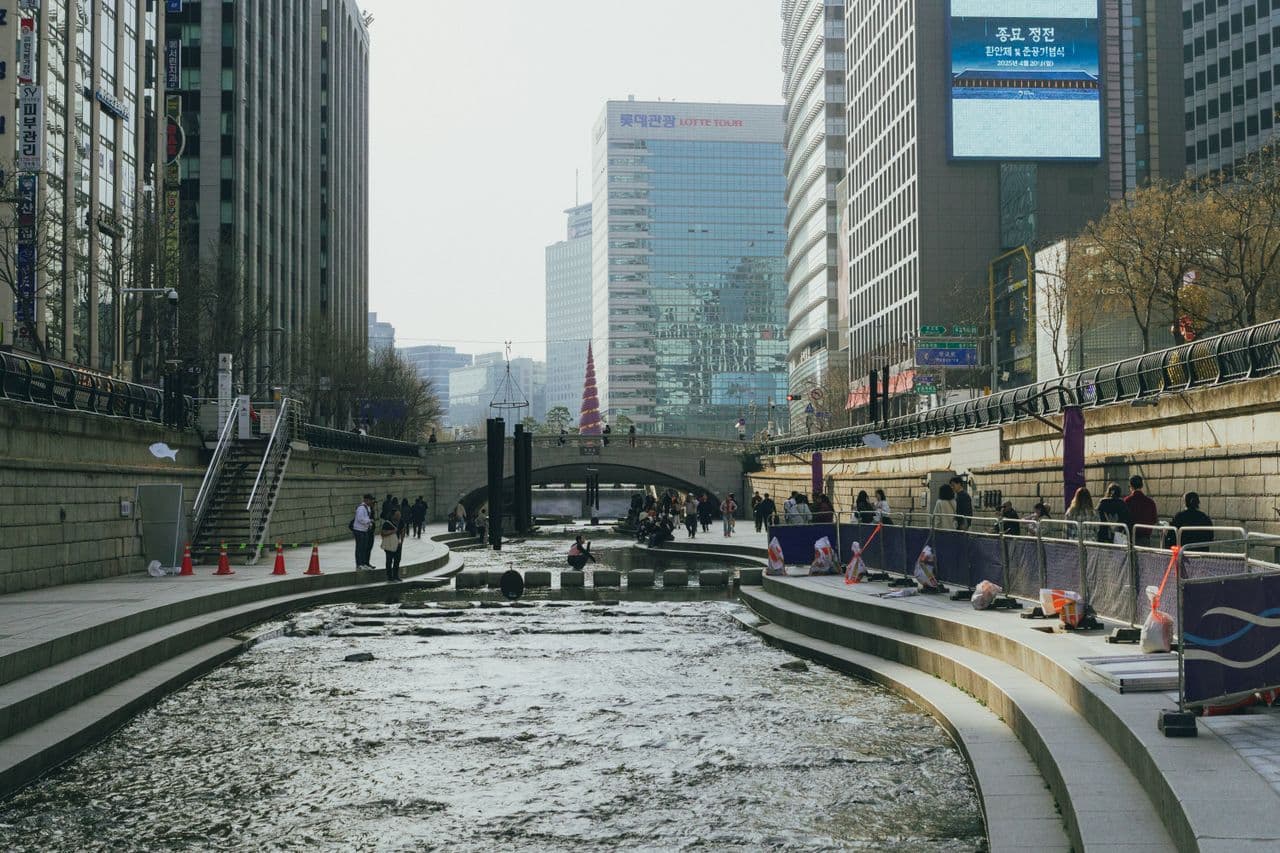
Yunjungno runs alongside Cheonggyecheon stream in the heart of Seoul. This rehabilitated pedestrian promenade on a former elevated highway offers verdant banks, footbridges and nighttime lights between Gwanghwamun and Dongdaemun.
Yunjungno is the pedestrian avenue that runs alongside Cheonggyecheon stream in central Seoul. Rehabilitated in the early 2000s after the demolition of an elevated highway, this urban promenade stretching several kilometres connects the Gwanghwamun district to the eastern part of the city. It offers a striking contrast between concrete, flowing water and vegetation at the heart of a dense metropolis.
What to see
Along Cheonggyecheon stream, pedestrian footbridges span the water at regular intervals. The landscaped banks host benches, seasonal plantings and public artworks. At night, illuminated installations reflect across the water. Upstream, near Cheonggye Plaza, a large artificial waterfall marks the symbolic starting point of the route.
History and context
Cheonggyecheon was a natural watercourse running through Seoul since the Joseon period. Covered and later transformed into a highway in the twentieth century, it was restored between 2003 and 2005 under the initiative of Mayor Lee Myung-bak. This urban renewal project became an international reference for the conversion of road infrastructure into public space.
Highlights of the visit
The starting waterfall
At the western end, near Cheonggye Plaza, an artificial waterfall adorned with a mural inspired by Joseon painting marks the entrance to the route. This is the classic starting point of the promenade.
Footbridges and banks
Dozens of small footbridges allow crossing from one bank to the other. Some are made of stone, others of metal. The banks descend in steps to the water, allowing visitors to sit at stream level.
Nighttime illuminations
In the evening, lanterns and light projections animate the banks, particularly during the Cheonggyecheon lantern festival, held each autumn.
Photography tips
Golden late-afternoon light illuminates the banks well, oriented east-west. At night, reflections of illuminations in the water offer interesting compositions from the footbridges. In autumn, the coloured foliage of trees planted along the banks adds depth to your framing.
Location and access
Yunjungno runs alongside Cheonggyecheon from the Gwanghwamun district eastwards. Several metro stations provide access to the stream along its course. The promenade is entirely pedestrian and accessible by pushchair or wheelchair over most of the route, although some stepped banks are not wheelchair accessible.
Nearby attractions
- Gwanghwamun Plaza — grand historic esplanade with the statue of Admiral Yi Sun-sin, at the western end of the stream.
- Gyeongbokgung Palace — principal royal palace of the Joseon period, a few minutes' walk to the north.
- Insadong — district of crafts, galleries and traditional teas, accessible from stations near the stream.
- Dongdaemun — former city gate and fashion district, at the eastern end of the route.
Frequently asked questions
The promenade is open continuously. In winter, the stream may be partially frozen, but the banks remain walkable.
A walk from end to end covers several kilometres. Allow one to two hours depending on your pace and stops.
Access to the Cheonggyecheon banks is entirely free.
Spring (flowers) and autumn (foliage, lantern festival) are the most pleasant seasons. Summer can be hot and humid.
Yes. The stream naturally connects Gwanghwamun to the west and Dongdaemun to the east, making it possible to combine the promenade with visits to these two districts in a single day.
Interested in this visit?
We can include it in your personalised itinerary.