Buyeo
Buyeo
Former capital of the Baekje kingdom and UNESCO World Heritage site, Buyeo concentrates 1,500 years of Korean history between a mountain fortress, a thousand-year-old pagoda, and lotus ponds.
Ancient capital of the Baekje Kingdom, Buyeo is a city steeped in rich history. From its past, it has preserved several treasures that allow visitors to trace the history and cultural identity of the country. Today a peaceful city, it makes for a pleasant respite far from urban hustle during a stay in South Korea.
History
Buyeo is a charming small town with a turbulent past. Indeed, in 538, it was the capital of one of the country's most powerful kingdoms, the Baekje Kingdom. During its tenure as capital, the city experienced unprecedented prosperity. However, just over a century later, in 660, it fell to attacks by one of its allies, the Silla dynasty, supported by the Chinese Tang dynasty. Following this defeat, Buyeo was pillaged and then abandoned. Today, archaeological excavations conducted at the site of this ancient capital have revealed treasures that bear witness to its rich past.
Visiting Buyeo's Historic Sites
Today, Buyeo is a calm city with a relaxed atmosphere. From its past, it preserves several treasures whose visit is highly recommended to better understand the country's history and cultural identity. Among them is the Buso Mountain Fortress, or Busosanseong. It is an impressive fortress located north of the city center. Its construction dates to the era when Buyeo was still the capital of Baekje . Since 2015, this site has been part of the UNESCO World Heritage, within the group of historic areas of Baekje.
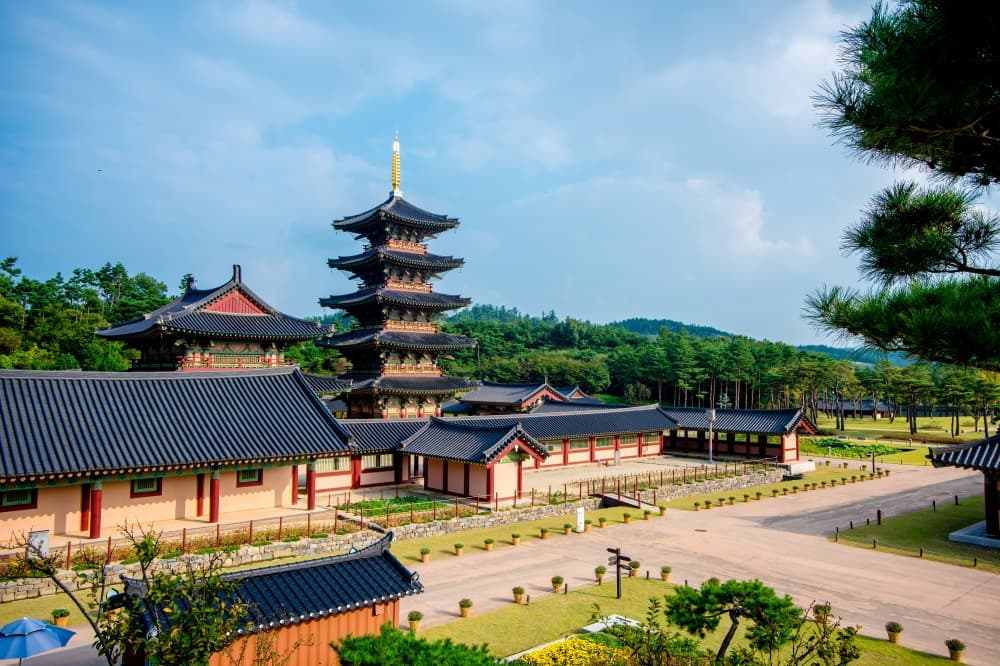
The Jeongnisima Temple and Museum also deserve a visit. Located in the eastern part of the city center, these monuments house a complex with the ruins of a lotus pond, a Buddha statue, and a five-tiered pagoda over 1,500 years old. The museum itself features an impressive scale model reconstruction of what the temple once was.
Another site not to be missed is Buyeo National Museum. Located a few blocks south of Jeongnisima Temple, this institution houses approximately 13,000 collection objects, most of which were discovered through archaeological excavations. As for the sites that enabled these discoveries, Songguk-ri is a must-visit. It is one of the region's most important sites. Its significance, particularly in the study of Korean prehistory, earned it the designation of historic site of the country.
Moreover, Buyeo is also home to several parks, including Baekje Historic Park, renowned for its numerous reconstructions of ancient monuments in the region, and Seodong Park, a sculpture park showcasing the work of the peninsula's finest artisans.
Climate
Buyeo enjoys a humid continental climate. Average temperatures range from −1.9 °C in January to 25.5 °C in August.
Geography
Buyeo is located in the lower Geum River valley in a hilly region south of the Charyeong mountain range. Its main hills are Seongtaesan (631 m), Wolmyeongsan (544 m), and Mansusan (432 m). It sits 60 km west of Daejeon and 40 km east of the Yellow Sea. Since 2009, the city has been traversed by Highway 151, which connects Gongju to Seocheon. However, it is not yet accessible by train.
Buyeo is accessible only by road. To get there, you have a choice between renting a car or taking the bus. However, if you're traveling from Seoul, you don't need to make the entire journey by bus. In fact, you can take the train to Nonsan, the nearest station to Buyeo, and complete the remaining distance by bus.
Want to discover this destination?
Our local advisors design your tailor-made trip.