Cheonghakdong
Cheonghakdong
At the foot of Mount Jirisan, Cheonghakdong has preserved a pre-Joseon way of life for 400 years: hanbok, calligraphy, and bamboo salt. Your complete guide.
Named the "village of the blue crane," Cheonghakdong refers to a small community situated at the southern foot of Samsanbong Peak, on Mount Jirisan. Its calm, verdant landscape reveals its true authenticity.
Evoking both a purely traditional spirit and style, Cheonghakdong was recently considered South Korea's most traditional and authentic village. Unfortunately, with the arrival of tourism, the village has gradually modernized, causing its characteristics and authentic charm to fade.
History
Once known as the "village of Taoist masters," Cheonghakdong was founded by villagers over 400 years ago. The Japanese invasion of 1592 forced them to flee the domain, which had already housed more than 100 dwellings. The destruction aimed to eradicate rebellious communists who had hidden in the region during the Korean War. Ultimately, the area was in no way involved in the country's tumultuous history.
A community of roughly a hundred people settled there. They lived as if in the Joseon era, following a religion blending Taoism, Confucianism, and local religions that forbade them from embracing progress. Inhabitants wore traditional clothing, and men kept their long hair and beards.
Today
The village of Cheonghakdong today has 200 residents, spread across some thirty traditional houses made of earth or stone. It is a part of South Korea that has primarily oriented itself toward farming. Nevertheless, locals have gradually begun to embrace current technological advances. Despite the villagers' archaic appearance and behavior, this small hamlet enjoys an evolving daily life thanks to electricity and paved roads leading to the city.
The village also represents the sacred site of the cult of the 3 mythological founders of the region, namely Hwanin, Hwanwung, and Dangun.
Distinctive Features of Cheonghakdong Village
The site exudes a warm and welcoming atmosphere. Your visit centers on a place where nature predominates, whether through the activities of inhabitants or through the landscape itself. A detour here will allow you to uncover several pleasant surprises.
Beyond ancient symbols found throughout the site, the village is characterized by the mutual respect of residents, especially toward the elderly wearing hanbok, with long white hair and beards. You can observe them crouched in front of their homes, gracefully engaged in one of their primary activities: calligraphy. You may also encounter them along your way. Tradition dictates that the word "Annyeonghasseyo" (hello) be addressed to them as is fitting. Nowadays, this custom remains practiced in certain regions of South Korea.
Above the valley stands a traditional tea salon, also called Yetchajip. Along the way, you may spot shops selling local products such as bamboo salt, used for cooking and also maintaining good skin hygiene. It's worth noting that bamboo is extremely abundant within and around the village.
Take the opportunity to sample a delicious scallion pancake, pajeon. Entry to the site requires an admission fee.
Near Cheonghakdong
From Cheonghakdong village, a hiking path allows you to reach one of the highest peaks in South Korea, standing within the national park bearing the same name, Jirisan. By extending your journey further, you will then have access to Samsinbong and the Seseok Refuge, a 5.5-hour walk away. Another route of 50 minutes will lead you directly to Ssangyesa Temple.
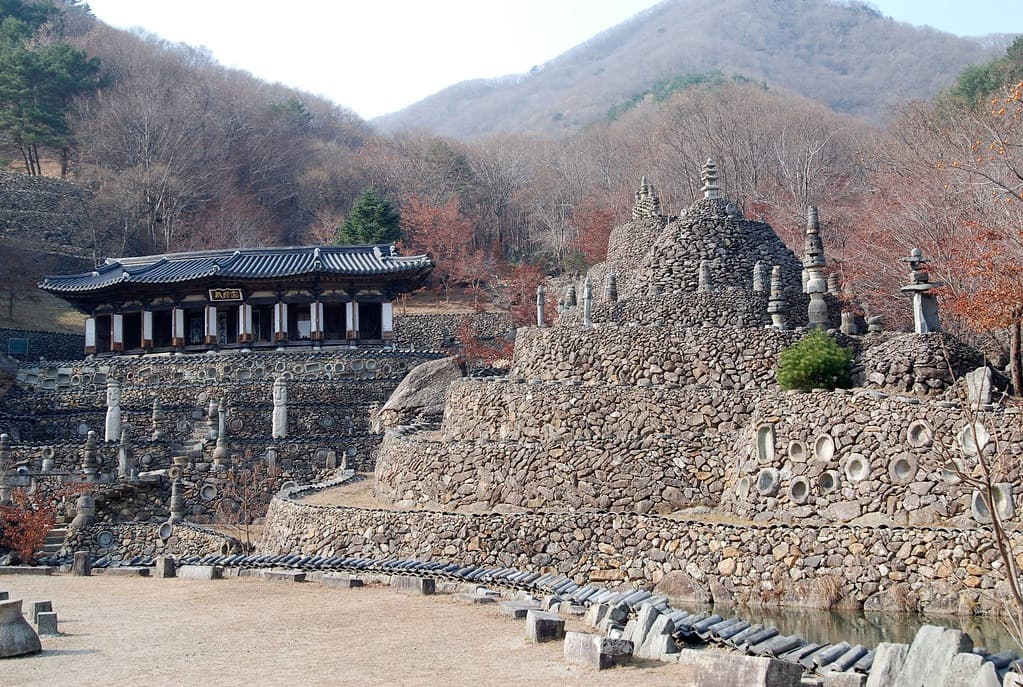
At the same time, you will benefit from an interesting discovery located below the village: Samseong-gung, the fortress with 1,500 toltap, or stone towers. Exploration requires a guided tour, and the site is open from March to October and November to February, following a set schedule. Aside from a few rituals to honor, visiting a small cave, a folklore objects exhibition hall, and an altar dedicated to a founder of the Korean nation, you will have the opportunity to spot an English-language museum housing a Buddha statue dressed in hanbok. Spaces reserved for ceremonies further enhance the region's traditional atmosphere.
Generally, one notes a certain inclination toward respecting ancestral customs, compared to visits made. For adventure enthusiasts, transform your perspective into a pilgrimage scene within moments. Clearly, this destination encourages you to immerse yourself in total cultural immersion.
Climate in Cheonghakdong
Cheonghakdong enjoys a warm temperate climate of Cfa type, with significant rainfall throughout the year, observed even during the driest months. Annually, the site displays an average temperature of 12°C and precipitation of 1,279 mm.
There are 5 options to reach Cheonghakdong village. Note that routes depart from the city of Jinju.
Bus
Bus line no. 8 is recommended for approximately 2.5 hours of travel. A ticket costs around $9. Via Naeso, the fare could increase to $12, with 4 hours of travel time.
Train
The Boseong train allows you to reach Cheonghakdong village in approximately 2 hours. Fares range between $16 to $19.
Rental Car
This mode of transportation proves to be the most convenient. The route requires approximately one hour of driving, covering 109 km.
Want to discover this destination?
Our local advisors design your tailor-made trip.