Daejeon
Daejeon
Just 50 minutes from Seoul by KTX, Daejeon blends pioneering laboratories, thermal springs, and dramatic landscapes. An underrated stop on any South Korea itinerary.
Located less than an hour from Seoul by KTX, Daejeon is a destination that fuses discovery, adventure, and genuine cultural immersion. Regarded as the country's high-tech capital, it appeals to every type of traveler, regardless of age. Moreover, its proximity to major cities across the country makes it an essential stop during your South Korea trip.
A Glimpse into History
According to historical records, Daejeon was inhabited as far back as the Paleolithic era, or Stone Age. It was subsequently occupied by the Baekje Dynasty, the Silla Dynasty, and the Joseon Dynasty. Once nothing more than a small village with few residents, Daejeon experienced remarkable growth beginning in 1905, when the first railway line connecting the city to Seoul and Busan was constructed.
In 1926, the Honam Line linking Daejeon to Mokpo was completed. Thanks to this railway, Daejeon became one of Korea's most important transport hubs, accelerating its development. In 1932, it became the capital of South Chungcheong Province. In 1997, the Daejeon Government Complex was built with the goal of relocating some administrative offices from the already densely populated capital, Seoul.
Discovering Daejeon
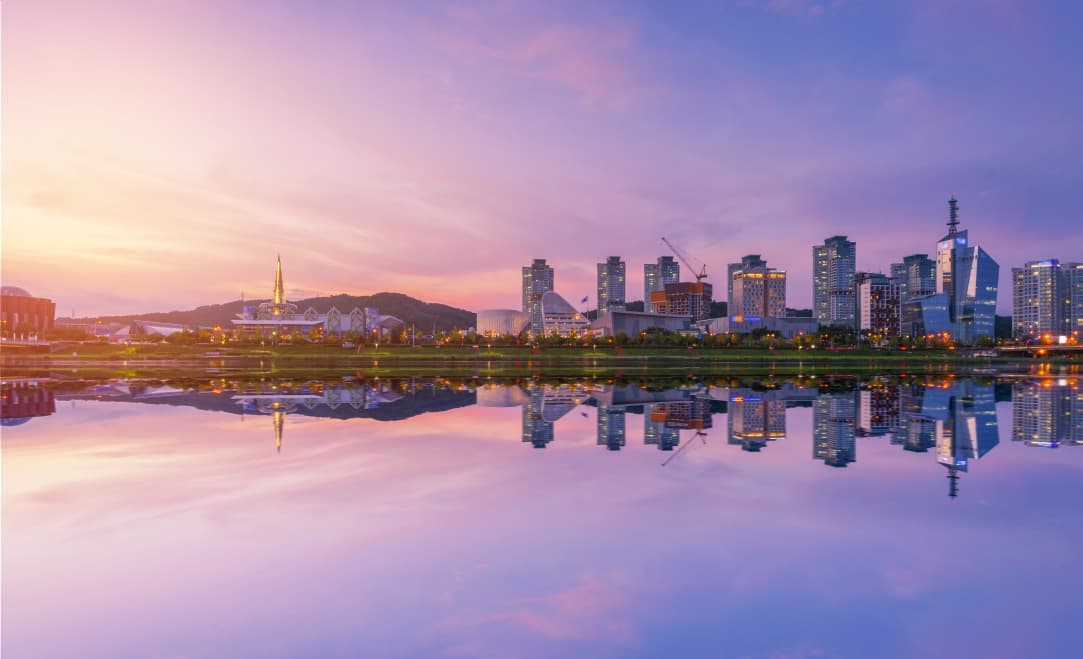
Today, Daejeon is South Korea's fifth-largest city, home to over 1.5 million residents. It is recognized as the country's scientific and technological capital thanks to the presence of prestigious research institutions such as KAIST (Korea Advanced Institute of Science and Technology) and ETRI (Electronics and Telecommunications Research Institute). Like other major South Korean cities, Daejeon has adopted the slogan: "It's Daejeon". Literally meaning "it's Daejeon," the letters IT'S also stand for I for Interesting, T for Tradition and Culture, and S for Science and Technology.
In terms of tourism, Daejeon is a city with plenty to offer its visitors. Among the must-sees is the Festival of Filial Piety and Family Roots Culture. This is an event organized by the city held at Ppuri Park (Family Roots Park) over three days in May. During the festival, you can attend numerous parades, ceremonies honoring ancestors, and various other activities. Beyond this festival, the Daejeon History Museum is equally worth a visit. This cultural venue houses multiple exhibition halls with different themes, each offering diverse programs.
Daejeon Expo Park is another excellent destination not to be missed. A space dedicated to science and technology, you'll find various attractions showcasing incredible scientific experiences. The park also features a recreation center offering both novel and entertaining activities. These include the world's largest IMAX cinema, a Maglev train (monorail), a convention center with interpretation services in six languages, and more.
Another site to not overlook is KOTREX, the KOTRA Exhibition Center. This is one of Korea's largest exhibition halls, with a total area of 29,195 m². The center is divided into two exhibition spaces: an indoor space accommodating up to 5,000 people and an outdoor area.
Geography
Daejeon is a city situated in a vast plain at the heart of South Chungcheong Province. Daejeon serves as a major transport hub in Korea's network, connecting major cities such as Seoul, Busan, and Mokpo.
Climate
Daejeon enjoys a climate straddling humid continental and humid subtropical zones. Average monthly temperatures range from −1.9 °C in January (though they often drop below −10 °C) to 25.5 °C in August (where temperatures can reach 35 °C). The city experiences four distinct seasons, with summer being the most pleasantly warm period.
How to Get There
Daejeon is a major road and rail junction in South Korea, making it relatively easy to reach. Your options include:
KTX: The journey takes approximately 50 minutes from Seoul.
Bus: From Central City Seoul bus terminal, take a direct bus to Daejeon.
Plane: The nearest airport is Cheongju International Airport, near the city of Cheongju, at least 30 minutes by road north of Daejeon.
Getting Around
Daejeon boasts an excellent urban transport network. Moreover, the Hankkumi, a rechargeable card, can be used across buses, the metro, and taxis. These cards are available at metro station kiosks and can be reloaded at train stations and convenience stores.
What to See and Do
· Attend the Festival of Filial Piety and Family Roots Culture.
· Visit the Daejeon History Museum.
· Explore Daejeon Expo Park.
· Browse exhibitions at KOTRA or KOTREX.
Want to discover this destination?
Our local advisors design your tailor-made trip.