Gongju
Gongju
An ancient capital of the Baekje Kingdom and UNESCO World Heritage site, Gongju reveals thousand-year-old fortresses, royal tombs, and Buddhist temples just 2 hours from Seoul.
Gongju is a compelling stop during a trip to South Korea. This former capital of the Baekje Kingdom is home to remarkable vestiges from that era whose exploration will illuminate the history of the Korean peninsula. Yet despite being a city steeped in history, it has embraced modernity, allowing visitors to enjoy their journey in complete comfort.
A Glimpse Into History
Gongju is a city in the southwestern center of the South Korean peninsula, 150 kilometers south of Seoul. It was known as "Ungjin" during the Baekje Kingdom era, when it served as the capital. As the seat of the most powerful kingdom in the country at the time, Gongju was constantly threatened by Goguryeo, a kingdom occupying what is now North Korea. Moreover, this rival power is famous for invading the previous Baekje capital, "Hanseong"—today known as Seoul.
More recently, Gongju was at the center of intense debate when South Korean Prime Minister Lee Hae-chan announced on August 11, 2004, the relocation of South Korea's administrative capital from Seoul to Gongju and Yeongi, a project scheduled for completion by 2030. The plan involved relocating government and administrative functions along with Parliament and the Supreme Court. This initiative was intended to reduce the overcrowding and economic dominance of Seoul over the rest of the country. It was also linked to strategic considerations—relocating the government would place it beyond the range of North Korean artillery. At that time, relations between the two nations remained deeply tense.
The projected cost of this operation was estimated between 45 and 94 billion dollars. This sparked fierce controversy, particularly from opposition parties who called for a national referendum to gauge public opinion. Given the project's magnitude, the referendum did take place. Yet surprisingly, the results clearly showed that only a narrow majority of the South Korean population opposed this government relocation.
Gongju Today
Setting aside the endless debate over moving the country's administrative capital, Gongju is an attractive destination that would be regrettable to miss during a trip to South Korea. You can begin your visit at the National Museum, where treasures accumulated by King Muryeong during his reign are preserved and displayed. Next, you can explore the reconstruction of a traditional village, known as "Hanok."
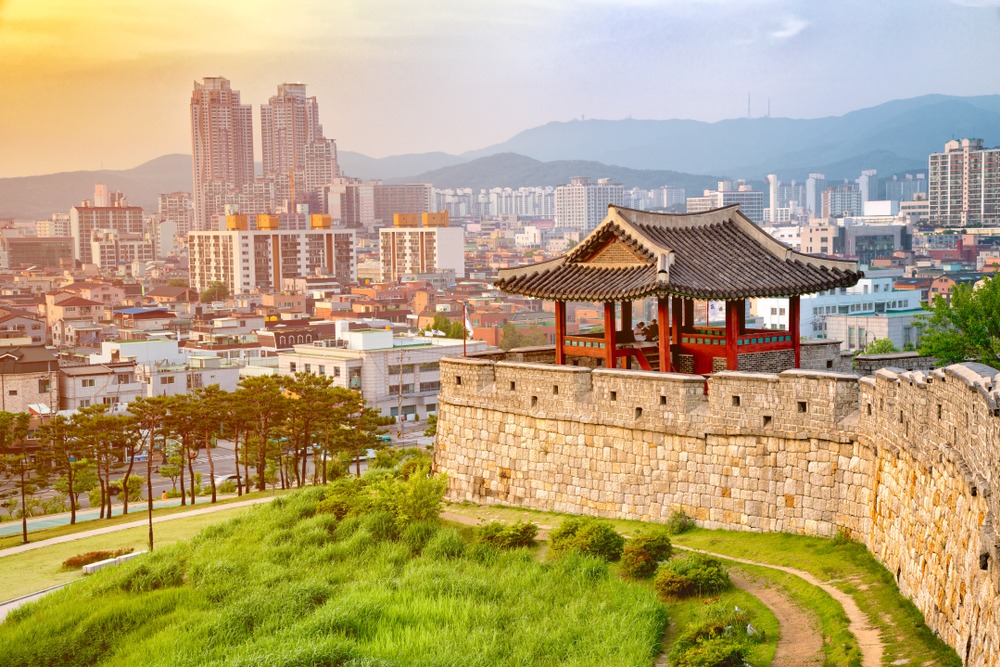
Continuing your exploration of Gongju, venture into the old town to admire Gongsanseong Fortress and its ramparts. Though little remains of the original structure, visiting this citadel—over 1,500 years old—offers an unforgettable experience, particularly during the changing of the guard ceremony. Moving further along the main road, you'll encounter the Songsan-ri burial mounds, a complex of seven tombs, the last of which belongs to King Muryeong.
Geography
Gongju is a small town located 150 km south of Seoul and 30 km northwest of Daejeon, the nearest major city. With approximately 130,000 inhabitants, it ranks 65th among the country's urban areas. The city is divided in two by the Geum River, but connected by 4 bridges allowing passage from one side to the other.
Getting There
By Bus:
Gongju is served by numerous buses from major cities including Daejeon, Seoul, Cheongju, and Buyeo.
By Car:
If you plan to reach Gongju by car from Seoul, take Highway No. 25 to Nonsan. Continue on Highway No. 1 to Daejeon. From Daejeon, take Highway No. 32 to Cheongju. Finally, from there, take Highway No. 36 to Gongju.
Getting Around the City
By Bus:
Gongju boasts an excellent urban bus network.
By Bicycle:
The city also operates a bike-sharing system.
On Foot:
Most tourist sites, including the Songsan-ri burial mounds complex, the National Museum of Gongju, and Gongsan Fortress, can easily be reached on foot and are no more than a ten-minute walk from one another.
What to See and Do
- Visit the National Museum
- Explore the Songsan-ri burial mounds
- Witness the changing of the guard at Gongsan Fortress
Want to discover this destination?
Our local advisors design your tailor-made trip.