Seongeup Folk Village
Seongeup Folk Village
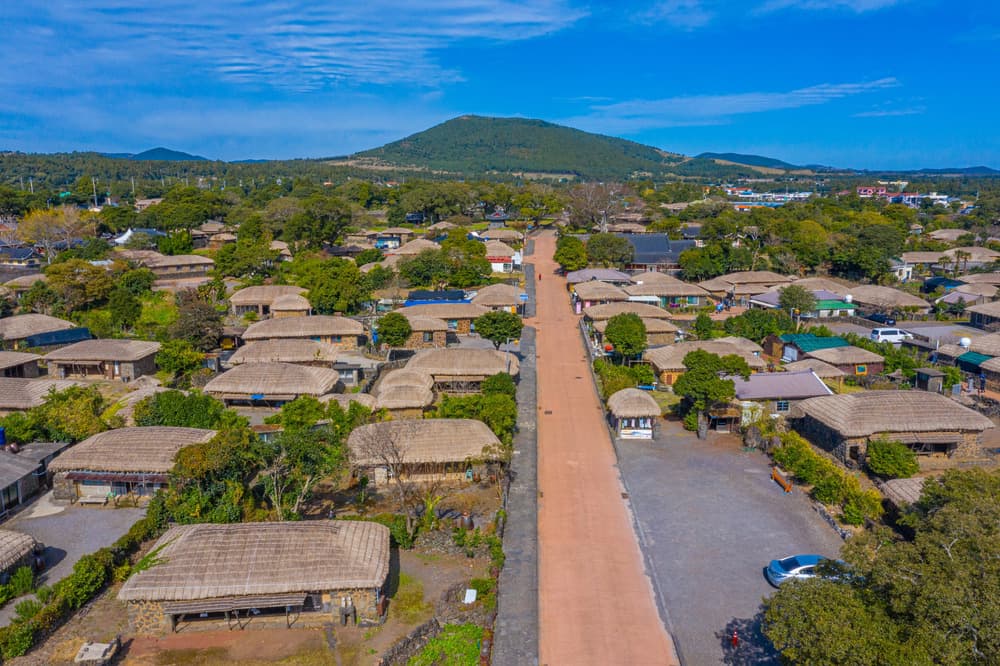
At the foot of Mount Hallasan, Seongeup Folk Village preserves Jeju's rural soul: black stone houses, thatched roofs and traditions still very much alive.
Seongeup Folk Village sits at the foot of Mt. Hallasan on the island of Jeju. The site offers insight into the history, culture and traditional lifestyle of the island's inhabitants. What sets it apart from similar attractions is that it remains inhabited—its residents serve as living guides.
History
This site was once the capital of the Cheongeui-Hyeon tribe. Though established in the 19th century, it is beautifully preserved, representing a living tableau of the island's fishing communities of yesteryear.
The village opened to the public in 1974 and draws considerable visitors annually. To preserve its cultural significance, the South Korean government provides residents with monthly allowances and additional benefits such as free electricity and water. The villagers continue to practice traditional crafts.
Seongeup Folk Village served as a filming location for the acclaimed South Korean television series Dae Jang Gum, which aired in 2003.
Exploring Seongeup Folk Village
The site is expansive and home to numerous cultural monuments. You'll discover the residence of the district governor of Jeonju, reconstructed in 2014 but tracing its origins to 1423. Numerous dwellings dot the village, some once inhabited by the upper classes. All homes are crowned with thick thatched roofs that evoke the image of giant mushrooms. Their walls were built with the island's black stone, formed from volcanic lava. Some properties feature vegetable gardens and cattle shelters. Daily life unfolds through artifacts—kitchen utensils, earthenware jars and other household objects.
The house fences are also constructed from stone, standing roughly 50 cm high with no gates but rather removable bars—a distinctive Jeju Island characteristic. On either side of each courtyard's main entrance typically stand two rocks pierced with holes to hold the bars. The number of bars conveyed a message about the owner's presence. For instance, a single bar indicated children were home and the owner would return soon. Two bars signaled the owner's absence from morning through afternoon.
East of Seongeup Folk Village stands the Jeongeui Confucian Shrine, also dating to 1423 and renovated in 1967. Within rests a wooden tablet inscribed with the Chinese character "Jeon," meaning "King." Two trees designated as natural monuments grace the village. One is a Japanese zelkova over 1,000 years old. The other is a hackberry tree exceeding 600 years.
Other monuments include stone statues, fortress ruins and millstones. During your visit, you'll also encounter Jeju's black pigs, a breed that has become synonymous with the island.
Practical Information
Opening Hours and Admission
Seongeup Folk Village is generally open daily. Admission costs approximately 11,000 won.
To reach the site, take a bus toward Beonnyeong-ro from Jeju Intercity Bus Terminal. Disembark at Seongeup 1-ri samuso. From there, walk roughly 200 meters. The journey takes approximately 1 hour and 40 minutes. You may also take a taxi from Jeju city.
Want to discover this destination?
Our local advisors design your tailor-made trip.