Gangwon and Eastern Mountains
The mountainous quarter of Corée du Sud, between the ridges of Seoraksan, the temples of Odaesan and the open-sea coast of Gangneung-Sokcho, two hours by KTX from Seoul.
Gangwon occupies the northeast quarter of the peninsula, wedged between the East Sea and the North Korean border. It is the country's most mountainous region: the Taebaek range peaks here at 1,708 m at Daecheongbong, the summit of Seoraksan National Park. Our team in Seoul receives many requests for this region in autumn and winter, two seasons when it truly comes alive. For the rest of the year, it holds appeal for those seeking to venture beyond the Seoul-Gyeongju-Busan triangle and hike seriously.
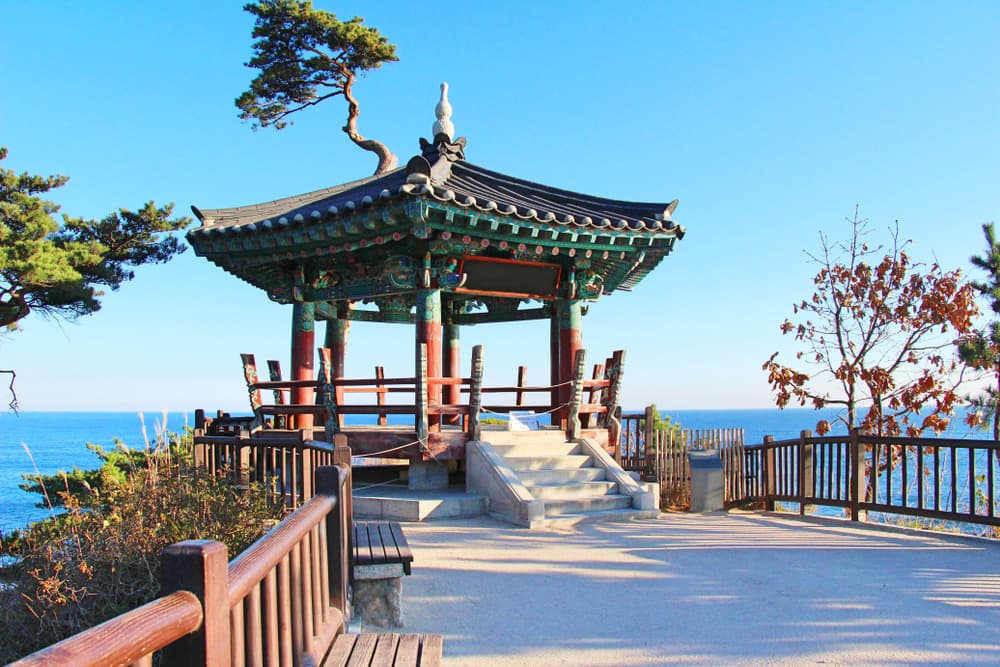
Geography dictates everything here. To the west, the inland slopes descend toward the agricultural valleys of Pyeongchang and Hoengseong, known for hanwoo beef and buckwheat fields that inspired Lee Hyo-seok's short story, read in every Korean school. To the east, the slope is steeper: the mountains plunge 30 km to a straight coastline lined with the ports of Sokcho, Yangyang, and Gangneung. This coast belongs to the East Sea, without islands or bays, swept by open-ocean swells. Fishermen here work squid, snow crab in winter, and hoe—Korean-style raw fish—is savored in the tidal markets of all three ports.
Seoraksan remains the heart of hiking interest. The park divides into Outer Seorak (Sokcho side, fastest access), Inner Seorak (Inje side, wilder), and South Seorak (around the Osaek hot springs). Routes range from the 2-hour walk to Sinheungsa Temple to the 11-hour traverse to Daecheongbong with a night in a mountain hut. The neighboring Odaesan park, centered on Woljeongsa Temple and its 9th-century stone pagoda, offers gentler hiking along wooded ridges, through mixed forest of oak and Korean fir.
Gangneung transformed with the 2018 Winter Olympics, held in Pyeongchang and along the Gangneung coast. The city has retained a dense café scene, rooted in a local tradition predating the Games: Anmok Street, facing the sea, lines some thirty roasters and tea rooms. The Dano Festival of Gangneung, UNESCO-listed, takes place in early June by the lunar calendar and blends shamanic rites, masks, and ssireum wrestling. Further north, Sokcho preserves an Abai quarter, founded by North Korean refugees in 1950, where you still eat ojingeo sundae ravioli—stuffed squid—and ham heung naengmyeon, cold noodles made with potato starch.
Winter marks the second peak season. The ski resorts of Yongpyong, Alpensia, and High1 receive reliable snow from mid-December through late February, with accumulations of 200 to 300 cm over the season. These are East Asian-style resorts: night grooming, slopes lit until 10 p.m., tower hotels at the base of the lifts. Skiing is easy, off-piste nonexistent. For non-skiing travelers, the same snow makes the low-altitude trails of Seoraksan manageable with light crampons, and the hot springs of Osaek or Cheoksan become inviting at temperatures of -10°C.
The Gyeonggang KTX, opened for the Olympics, connects Seoul Cheongnyangni to Gangneung in 1 hour 54 minutes, with stops at Pyeongchang and Jinbu (gateway to Odaesan). This is what makes the region accessible in a short loop from the capital, when previously it took 4 hours by bus.
Must-See
Gongnyong Ridge at Seoraksan. Rocky arête known as the "dragon's back" linking Madeungnyeong to Huiungak, 5 hours of exposed hiking with views over the East Sea. The maples turn crimson between October 10 and 25, depending on the year.
Woljeongsa Temple and Fir Forest. A one-kilometer avenue under Korean firs leading to the temple founded in 643, followed by the Seonjaegil trail that follows the river for 9 km to Sangwonsa Temple.
Abai Quarter in Sokcho. Village of North Korean refugees settled on a sandbar, crossed by a manual cable ferry. Here you eat squid sundae in small eateries run by the daughters of the founders.
Anmok Café Street in Gangneung. Waterfront transformed into a roasting quarter since the 2000s, with some thirty addresses. The adjacent beach hosts lunar new year bathing.
Osaek Hot Springs. Fizzy ferruginous waters at 30°C tapped at the foot of Seoraksan's south slope, exploited since the 15th century. A natural combination after a day's hike up Daecheongbong.
When to Go
Two windows dominate. Autumn, from late September to mid-November, brings color to Seoraksan and Odaesan: peak color occurs around October 15-20 above 1,200 m, then descends to lower elevations by mid-November. Daytime temperatures range from 15°C to 0°C at night in the high peaks. This is Korea's peak season; Seoraksan mountain huts book a month in advance through our office. Winter, from mid-December through late February, guarantees snow (200-300 cm accumulated over the season) with mountain temperatures of -5 to -15°C, milder on the coast (-2 to 5°C).
Spring (April-May) remains good for hiking, with Gyeongpo's cherry blossoms in Gangneung in early April, though the sky is often veiled by dust from China in March-April. Summer (June to mid-September) is the season to avoid: the Changma monsoon dumps 300 to 400 mm of rain in July, high-altitude trails close regularly due to mudslide risk, and the east coast beaches are saturated with domestic visitors in August.
Practical Tips
Budget a minimum of 2 days for a tight loop (Seoraksan + Gangneung), 3 to 4 days to combine hiking at Seoraksan, a day at Odaesan, and coastal culture in Gangneung-Sokcho. Beyond that, interest dilutes unless you're planning a week-long ski stay. The most efficient entry point remains the KTX from Seoul Cheongnyangni (1 hour 54 minutes to Gangneung, 2 hours 5 minutes to Jinbu for Odaesan), supplemented by bus or private car to reach park entrances. Sokcho is reached faster by express bus from Seoul (2 hours 20 minutes) than by train.
The region logically combines with Seoul and surroundings at the start or end of your itinerary, via simple day trips by KTX. Combining it with Gyeongsang and Busan requires a return through Seoul or a long, uninspiring east-west journey. Hotel comfort is adequate but unremarkable in Sokcho and around the parks (family guesthouses, minbak), good in Gangneung and the Pyeongchang resorts. This region suits serious hikers (Seoraksan trails are steep and long), winter travelers coming for snow, and those drawn to mountain temples. It suits families with young children less well, outside a ski stay.