Discover Jeonju
With its historic alleyways, preserved customs and traditional houses, Jeonju is one of the most authentic cities in South Korea!
With its historic alleyways, preserved customs and traditional houses, Jeonju is one of the most authentic cities in South Korea! Known for its hanok village and cultural festivals, it offers an immersion into the heart of Korean heritage. But visiting Jeonju also means discovering bibimbap, an emblematic local specialty…
Visiting Jeonju: 6 must-see stops
1. Its hanok village
The Jeonju Hanok Village extends across several streets at the heart of Jeonju's old town. Dotted with charming alleyways, this historic site is considered an emblematic cultural city in the country, much like Seoul's Bukchon Hanok Village.
Traditional houses
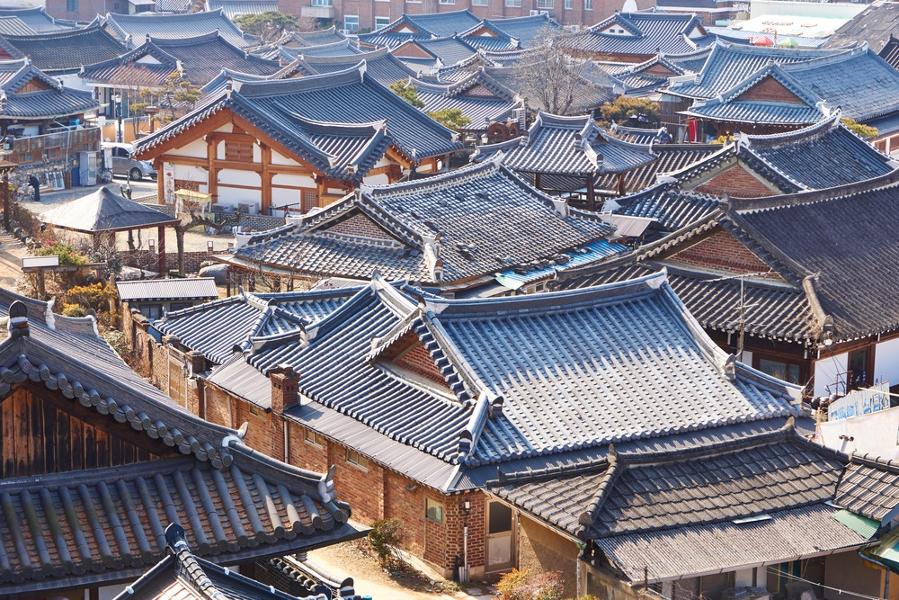
A hanok village is a collection of traditional Korean houses, preserved to reflect life and architecture of yesteryear. The Jeonju hanok village boasts approximately 800 residences dating from the late 19th century!
Hanok houses were designed with natural materials (stone, earth, wood and tiles) to harmonize with nature and adapt to Korea's climate. One of the oldest is the Hakindang house.
Designated as Folklore Property No. 8 (its heritage classification number), this historic house is occasionally used as a filming location, as was the case in 2018 for the Korean series Mr. Sunshine.
Pungnammun Gate
Just minutes from the village's heart stands Pungnammun Gate. Built in 1768, it is the last remnant of Jeonju's former fortress. Classified as a national treasure, it marks the southern entrance to the old town. It is also renowned as a spot to watch the sunset…
If you wish to spend an evening here, consider staying in a hanok! While some houses now host galleries or tea rooms, others function as guesthouses.
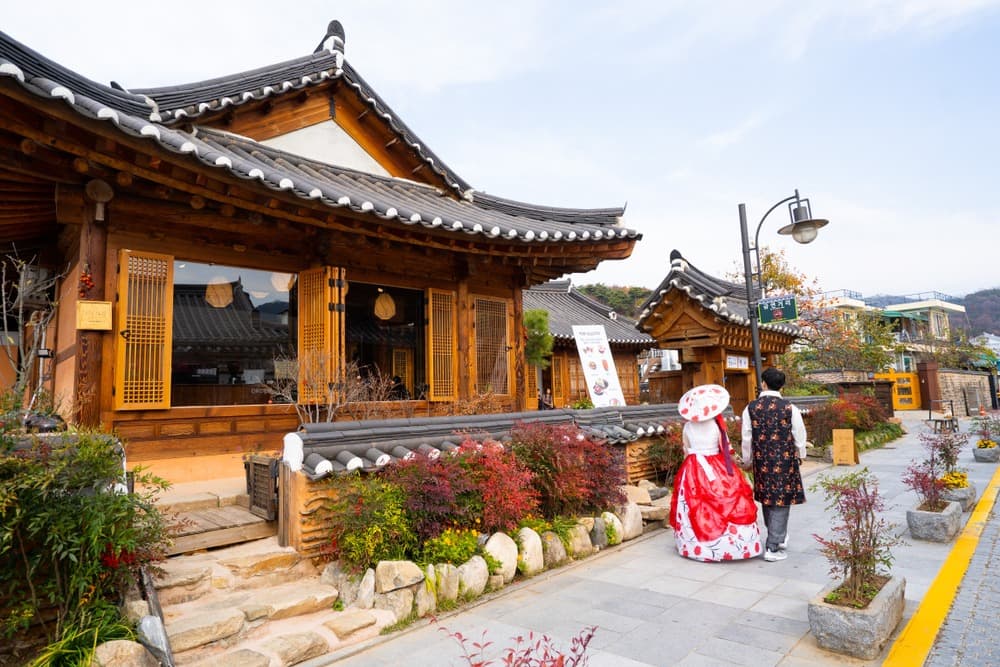
Rent a Hanbok outfit To capture beautiful "period photos" in the hanok village, don't hesitate to rent a traditional hanbok outfit from street vendors in Jeonju. This Korean garment, composed of a blouse (jeogori) and wide skirt (chima) for women, or a blouse and trousers (baji) for men, is the emblematic costume of the Joseon era. Rental prices vary depending on the duration of the loan and the accessories chosen to enhance the outfit… Some may find the experience a bit overly folkloric or touristy, but for others, it's an amusing opportunity to immerse themselves in Korean culture for a few snapshots… |
2. Jaman Mural Village
Not far from Pungnammun Gate, don't miss Jaman Mural Village. This former slum is now a true open-air museum—thanks to the Korean government's initiative to revitalize urban areas left abandoned, similar to Gamcheon cultural village in Busan.
You can see an eclectic mix of inspirations from pop culture, such as cartoon characters (Totoro or Nicky Larson), as well as heroes from Western cinema and literature (such as Edward Scissorhands or The Little Prince).
To discover all of Jaman's artworks, the best approach is to wander aimlessly and stumble upon discoveries… A tip? It's better to arrive early in the morning before the tourist rush, and to enjoy the beautiful morning light that reveals the colors of the murals!
3. Gyeonggijeon Shrine
Built in 1410, Gyeonggijeon Shrine was designed to house a portrait of King Taejo, founder of the Joseon Dynasty (1392-1910). The original portrait, classified as a national treasure, is preserved in the main hall. A copy can be viewed at the Royal Portrait Museum, located within the shrine grounds.
The museum also features other royal portraits (eojin), accompanied by explanations of clothing, postures and their symbolism.
The shrine, located at 44 Taejo-ro, Wansan-gu, was rebuilt in 1614 after the Japanese invasions. Access is through several traditional gates in a tree-lined park. It is open daily from 9 a.m. to 7 p.m. (6 p.m. in winter). Admission is 3,000 won (approximately €2.20).
4. Jeondong Cathedral
Built between 1908 and 1914, Jeondong Cathedral is one of the first Western-style Catholic buildings in Korea (designed by French priest Father Poisnel). It was erected on the very spot where the two first Korean Catholics, Yun Ji-chung and Gwon Sang-yeon, were executed in 1791 for their faith…
The cathedral blends Romanesque and Byzantine influences. It is recognizable by its red brick façade, central tower with twelve windows and two symmetrical domes. An unusual style here, contrasting sharply with the traditional houses in the nearby hanok district.
The church is open daily. However, it is recommended to avoid mass times and Sunday mornings if you simply wish to visit the cathedral without religious intent. Address: 51 Taejo-ro, Wansan-gu (free admission).
5. Nambu Market
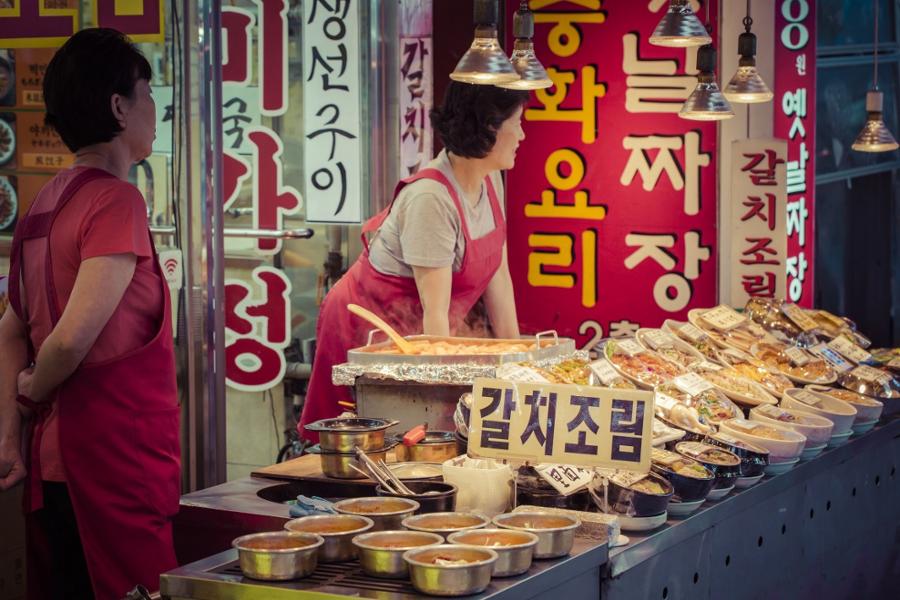
Nambu Market is an authentic place where visitors mingle with locals. Opening from 5:00 p.m., this bustling hub is prized for its lively atmosphere and narrow alleys—filled with all manner of goods (traditional outfits, souvenirs, etc.) but especially, an extensive selection of Korean street food (Bibimbap, Pajeon, Tteokbokki…)!
With affordable prices (roughly €3-4 per dish), it's the ideal spot to discover local specialties in a convivial atmosphere. Address: 19-3 Pungnammun 1-gil, Wansan-gu, Jeonju-si, Jeonbuk State (open year-round). Free admission.
6. Historic pavilions Omokdae and Imokdae
Venturing slightly away from the hanok village, you'll find a path leading to a pavilion perched on a hillside. This once belonged to Yi Seong-gye (better known as King Taejo) and offers a fine view over the rooftops of traditional houses.
A pedestrian bridge then allows you to reach a second pavilion, situated slightly lower on the opposite slope. This site is linked to Mokjo, Yi Seong-gye's great-great-grandfather, who is said to have resided here before leaving Jeonju.
Both sites can be visited freely. Plan for 30 to 45 minutes round-trip from the center of the historic village. Address: 55 Girin-daero, Wansan-gu, Jeonju. Open year-round.
What to do in Jeonju: 3 emblematic cultural activities
1. Attend the Jeonju International Sori Festival
Created in the early 2000s, the Jeonju International Sori Festival takes place each year in early October. Dedicated to traditional Korean music, it highlights pansori, a typical vocal art, while also featuring world music concerts.
In 2024, the festival ranked second in the International Transglobal World Music Chart (TWMC), which recognizes the world's best music productions.
2. Learn the art of hanji making
Hanji is a traditional Korean paper made from mulberry fiber. Renowned for its strength and durability, it is used for calligraphy, lanterns, sliding doors and crafts.
Its meticulous production involves extracting and beating the fibers before hand-sieving them to form sheets, then drying them in the sun. In Jeonju, several workshops offer the chance to discover this ancient art and leave with a unique, handmade souvenir.
3. Discover bibimbap (Jeonju's specialty)
Bibimbap is a Korean dish native to Jeonju. This dish—which literally means "mixed rice"—traces its origins to the city's prosperity, renowned for the quality of its agricultural products. More than a simple recipe of rice, vegetables and beef, bibimbap is a dish full of symbolism.
Beyond its visually colorful appearance, each ingredient of bibimbap represents an organ and cardinal direction:
Black/dark (shiitake, seaweed): north and kidneys,
Red/orange (chili, carrot): south and heart,
Green (spinach, cucumber): east and liver,
White (rice, soy, radish): west and lungs,
Yellow (egg): center and stomach.
This principle aims for harmony on the plate, both in flavor and symbolism! In 2012, Jeonju was designated a "city of gastronomy" by UNESCO. Each year in October, the Jeonju Bibimbap Festival celebrates this excellent intangible heritage.
How to get to Jeonju? Jeonju is easily accessible by train, bus or car. ● If you rent a car, allow three hours from Seoul, slightly more from Busan or Andong. ● From Seoul, the KTX train reaches the city in less than two hours with no transfers to Jeonju station, for around 27 euros. ● It's also possible to reach Jeonju by express bus from Seoul's central bus terminal. Once there, you can get around on foot or rent a Segway (scooter) or electric bike. |
Frequently asked questions
How long does it take to visit Jeonju?
One day is ideal for visiting Jeonju, as it allows you to stroll through the alleyways without rushing. It's also possible to spend a half-day here (the emblematic sites are located near each other) and dedicate the other half-day to other places of interest around Jeonju, such as Geumsansa Temple.
Where to stay in Jeonju?
While one day is enough to explore the Hanok village, spending a night in Jeonju allows you to stay in a traditional house for a true immersion in Korean culture!
What are reviews of Jeonju's hanok village?
Jeonju's hanok village is often described as a peaceful and exotic place, far from the hustle and bustle of major cities—though it can be touristy during the Jeonju Bibimbap Festival. You'll discover over 800 traditional houses, picturesque alleyways and little shops, all in a warm atmosphere.