Learning the Korean Alphabet: Hangul
Hangul is the official name given to the Korean alphabet, used in both South Korea and North Korea. This alphabet was created in 1443 during the Joseon dynasty.
Introduction to Hangul
Hangul is the official name given to the Korean alphabet, used in both South Korea and North Korea. This alphabet was created in 1443 during the Joseon dynasty. The Korean alphabet is composed of 19 consonants and 21 vowels, for a total of 40 letters (are you keeping up with me?!). Well, in reality it's a bit more than that if we consider certain combinations of vowels or consonants, but just remember that the main alphabet has 40 letters!
Unlike French, the letters don't follow one after another from left to right but are instead combined into sorts of blocks, generally containing 2 to 3 characters for each syllable to be formed.
Take the word "Han" for example, which is not written as "ㅎㅏㄴ" but rather as "한". You see the difference?
Another example with the word "Hangul" which is written 한글 and literally means "proverbs writing": Han (한) means "proverb" while Geul (글) refers to writing or language. One of the most interesting components of the Korean alphabet is the way characters are written. It's important to know that the shape of each letter is defined by the characteristics of the sound it represents. Consonants are thus based on the shape your mouth takes when you pronounce them, while vowels refer to horizontal or vertical lines.
The character ㄱ for example represents the shape your tongue takes when you pronounce the sound "g".Know finally that each consonant has its own name. ㄱ for example is called giyeok (기역).
For vowels it's a bit simpler fortunately, they are simply named according to the sound they produce (for example the sound "ah" for the vowel ㅏ).
Learning the Korean Alphabet
Now that you've had a little overview of how the Korean alphabet works, it's time to move on to learning each of the characters!
As we saw previously, each character of Hangul has its own name and pronunciation. Some characters are even pronounced differently depending on whether they appear at the beginning or end of a particular word.
Let's start with consonants!
Korean consonants
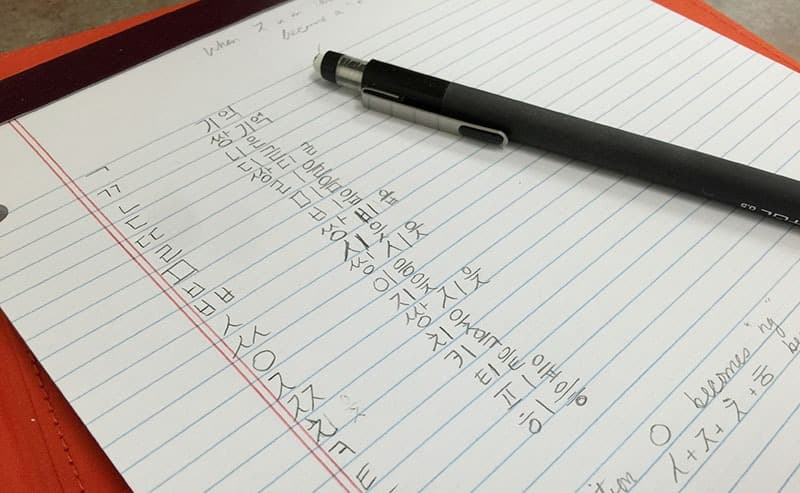
Here are the consonants of the Korean alphabet, with their name and the sound they produce next to them:
 Giyeok (기역):
At the beginning of a word: k
At the end of a word: k
 Nieun (니은):
At the beginning of a word: n
At the end of a word: n
 Digeut (디귿):
At the beginning of a word: t
At the end of a word: t
 Rieul (리을 ):
At the beginning of a word: r
At the end of a word: l
 Mieum (미음):
At the beginning of a word: m
At the end of a word: m
 Bieup (비읍):
At the beginning of a word: p
At the end of a word: p
 Siot (시옷):
At the beginning of a word: s
At the end of a word: t
 Ieung (이응):
At the beginning of a word: no sound
At the end of a word: ng
 Jieut (지읒):
At the beginning of a word: ch
At the end of a word: t
 Chieut (치읓):
At the beginning of a word: ch
At the end of a word: t
 Kieuk (키읔):
At the beginning of a word: kh
At the end of a word: kh
 Tieut (티읕):
At the beginning of a word: t
At the end of a word: t
 Pieup (피읖):
At the beginning of a word: p
At the end of a word: p
 Hieut (히읕):
At the beginning of a word: h
At the end of a word: no sound
Note that there are also several double consonants in the Korean alphabet. Here they are:
 Ssang Giyeok (쌍기역):
At the beginning of a word: g
At the end of a word: g
 Ssang Digeut (쌍디귿):
At the beginning of a word: d
At the end of a word: d
 Ssang Bieup (쌍비읍):
At the beginning of a word: b
At the end of a word: b
 Ssang Siot (쌍시옷):
At the beginning of a word: s
At the end of a word: t
 Ssang Jieut (쌍지읒):
At the beginning of a word: j
At the end of a word: t
Korean vowels
Vowels in Hangul don't have names like consonants do. Instead, they're given a simple sound to distinguish them, corresponding to their pronunciation. Many vowels have very similar sounds so it's up to you to make the distinction through practice.
If you're perceptive, you'll quickly notice that adding a line to each of these vowels amounts to adding a y to the sound, and adding a ㅗ or a ㅜ amounts to adding a w to it. Now for the characters!
 a
a
 eo
eo
 o
o
 u
u
 eu
eu
 i
i
 ae
ae
 e
e
 ya
ya
 yeo
yeo
 yo
yo
 yu
yu
 yae
yae
 ye
ye
 wa
wa
 wae
wae
 wo
wo
 we
we
 oe
oe
 wi
wi
 ui
ui
Now that you've had an overview of the consonants and vowels of the Korean Hangul alphabet, it's time to learn how to combine these characters into syllables and start writing words! This will be the subject of our next lesson
Frequently asked questions
Hangul is renowned as one of the easiest alphabets in the world to learn. With its 40 main letters (19 consonants and 21 vowels), most learners can master the basics in 1 to 2 weeks of daily practice of about 30 minutes.
The Hangul alphabet is used in both South Korea and North Korea, but with some differences. In North Korea, it's called Chosŏn'gŭl. The two variants share the same basic characters, but can differ in romanization and certain spelling conventions.
No, Hangul is generally considered much simpler than Japanese kanji or Chinese characters. With only 40 basic letters (compared to thousands of characters in Chinese), a beginner can start reading Korean phonetically in just a few days.
In Hangul, letters don't follow one after another from left to right like in English. They're combined into syllabic blocks generally containing 2 to 3 characters. Each block represents a syllable and combines at minimum a consonant and a vowel, as in the word 한글 (Hangul).
Yes, absolutely! Hangul is designed in a very logical and systematic way, which makes it accessible for self-study. Apps like Duolingo or Drops, YouTube videos and online guides allow you to learn the 40 basic letters without needing a teacher.