Bongeunsa Temple
Bongeunsa Temple
In the heart of Gangnam, Seoul, Bongeunsa is a Buddhist temple founded in 794 that houses a 28m Maitreya statue and offers a Temple Stay program.
Bongeunsa Temple occupies a sprawling Buddhist enclave spanning several hectares in Gangnam's business district, facing Coex Mall. Founded in the late 8th century, it brings together wooden pavilions, gardens, and a monumental Maitreya statue that towers above the surrounding skyscrapers. Its history—marked by persecution, fires, and the Korean War—makes it a living testament to Korean Buddhism.
Why Visit Bongeunsa Temple
Bongeunsa is one of Seoul's most active Buddhist temples. Its location in the heart of Gangnam creates a singular contrast: beyond the traditional gates, you glimpse the skyscrapers of the financial district. For travelers, it offers a chance to grasp in just a few hours the coexistence of modern Korea and millennia-old spiritual heritage, without leaving the capital.
The temple remains a place of worship frequented daily by devotees. Chanting, prostrations, and offerings shape the rhythm of the day, making it a living site rather than an open-air museum.
Twelve Centuries of History
The temple was founded in 794, during the Silla dynasty, under the name Gyeonseongsa. It was then located roughly a kilometer southwest of its current site.
Under the Joseon dynasty, Buddhism faced official suppression in favor of Neo-Confucianism. The temple nonetheless experienced a revival through reconstruction in 1498, supported by Queen Jeonghyeon. About fifty years later, Queen Munjeong revived royal patronage of Buddhism and appointed the monk Bo-wu in 1548 as the temple's first official leader. He would be assassinated years later, upon the queen's death, amid a resurgence of anti-Buddhist movements.
The site was subsequently occupied by the Seon sect (the Korean equivalent of Zen) until 1936. A fire in 1939 destroyed most of the buildings, and the Korean War further damaged the complex—only a single hall survived. Reconstructions have continued since. Before 1960, the current location was orchards and farmland; the temple expanded there progressively.
What to See on Site
The Maitreya Statue
Standing approximately 28 meters tall, the Maitreya Buddha statue ranks among South Korea's tallest Buddhist statues. Carved from stone, it rises in the upper portion of the complex and dominates all the pavilions. It is the site's most iconic photographic element.
The Daeungjeon and Main Pavilions
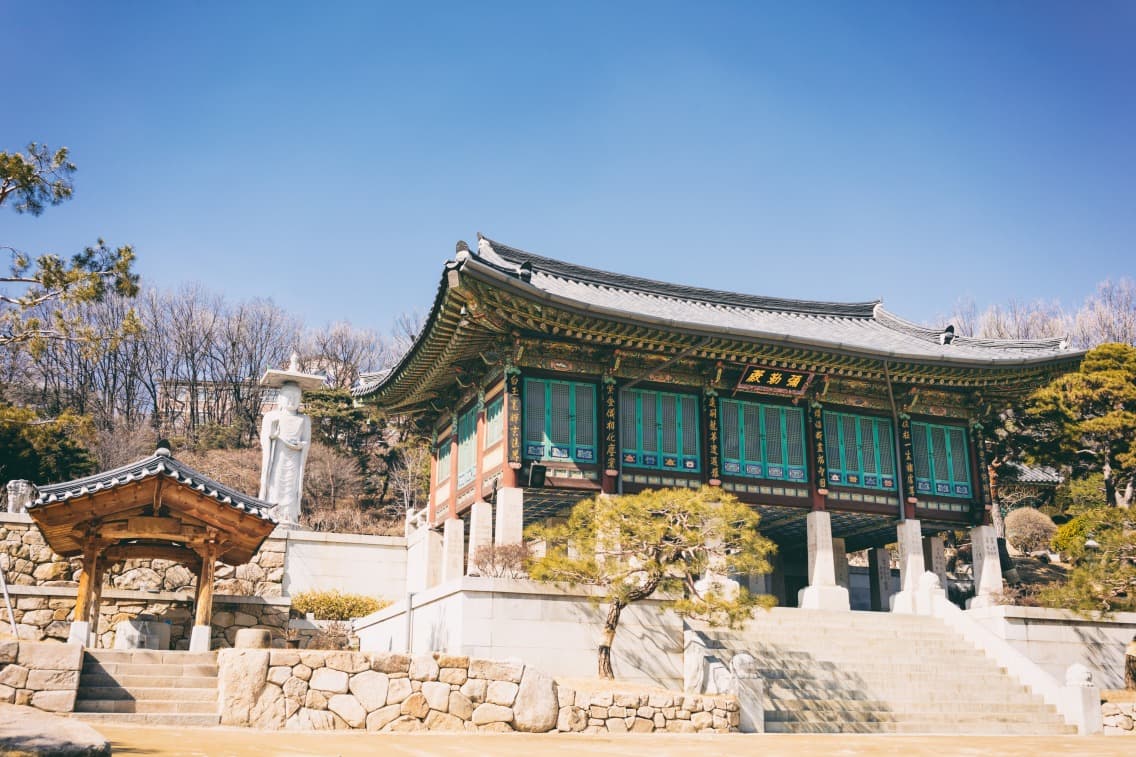
The Daeungjeon, the main hall dedicated to the historical Buddha, is the focal point of most ceremonies. Around it, several secondary pavilions house statues of bodhisattvas and offering altars. The architecture, restored yet faithful to traditional canons, merits close attention to the painted timberwork (dancheong) and double-pitched roofing.
The Panjeon and Its Treasures
The Panjeon houses 3,479 Buddhist scriptures in 13 types, as well as woodblock prints created in 1855 by monk Young-ki. This collection represents a rare textual heritage, testimony to the temple's religious publishing activity in the 19th century.
Practical Information
- Access: free and open to the public for the main site.
- Hours: open throughout the day, from early morning until evening. Ceremonies occur at fixed times; check the daily schedule at the entrance.
- Duration: allow 1 to 2 hours for a leisurely visit, longer if you attend a ceremony.
- Dress code: modest attire recommended, shoulders and knees covered in prayer halls. Remove shoes before entering pavilions.
- Languages: interpretation services available in English, Chinese, and Japanese.
- Parking: on-site parking available, complimentary for the first few minutes then paid at a modest rate.
The Temple Stay Program
Bongeunsa offers a Temple Stay program, organized notably on the fourth Saturday of each month. Participants share a few hours of monastic life: seated meditation, silent meals, tea ceremony, introduction to prostrations. A shorter program is also available for visiting international travelers. Advance booking is required through the temple's official website.
When to Visit
The temple welcomes visitors year-round. Two periods are particularly noteworthy:
- Spring (April-May): the Lotus Lantern Festival (Yeondeunghoe), celebrating the Buddha's birthday, transforms the site with thousands of paper lanterns suspended throughout the courtyards.
- Autumn (October-November): maples and ginkgos color the entire complex, making it an exceptionally photogenic period.
Summer is warm and humid, winter dry and cold but bright. Weekday mornings remain the quietest times.
How to Get There
The temple is located in Gangnam, in southern Seoul. The easiest access is by subway:
- Line 9, Bongeunsa station, Exit 1, then roughly 150 meters on foot to the main entrance.
- Line 2, Samseong station, Exit 6: allow about ten minutes on foot crossing the Coex complex.
Nearby Attractions
Bongeunsa fits naturally into a day exploring Gangnam. The Coex Mall, a vast underground shopping complex located directly across, houses the Starfield Library and an aquarium. The area around Gangnam station concentrates shops, restaurants, and cafés. To extend your Buddhist experience in Korea, several other temples are worth visiting:
- Haeinsa Temple, which preserves the Tripitaka Koreana;
- Magoksa Temple, nestled in a forested valley;
- Seokguram, a UNESCO-listed cave sanctuary near Gyeongju.
Frequently Asked Questions
Frequently asked questions
Including Bongeunsa in Your Itinerary
Bongeunsa Temple integrates naturally into a day dedicated to Gangnam or a broader exploration of Korean temples. To craft a bespoke journey combining Seoul, Buddhist sites, and nature, explore our South Korea travel packages.
Interested in this visit?
We can include it in your personalised itinerary.