Jogyesa Temple
Jogyesa Temple
Headquarters of the Jogye Order in the heart of Seoul, Jogyesa Temple brings together painted pavilions, gilded statues and centuries-old classified trees. Complete visitor guide.
In central Seoul, just steps from Gyeongbokgung Palace and the Insadong district, Jogyesa Temple is the headquarters of the Jogye Order, the primary school of Korean Buddhism. Founded in 1395, it occupies a modest yet heritage-dense compound: painted pavilions, centuries-old classified trees and monumental statues. It is one of the few active temples located in the heart of the capital.
Why visit Jogyesa Temple
Three reasons make a visit worthwhile. First, its function: it is the nerve centre of the Jogye Order, which unites the majority of Korean Buddhists. Ceremonies are held daily and are open to the public. Next, its heritage concentration: within a compact perimeter, you will see three gilded statues nearly five metres high, a classified pine tree designated as a natural monument, and a pavilion housing the four ritual instruments. Finally, its accessibility: located in immediate proximity to major metro lines and several major sites, it integrates easily into a day of sightseeing in Seoul.
History
The temple was founded in 1395 under the name Gakhwangsa, then renamed Jogyesa in 1910. During the Japanese colonial period (1910-1945), when Korean Buddhism faced intense pressure, it became a rallying point to preserve the country's religious identity. It subsequently established itself as the administrative and spiritual headquarters of the Jogye Order, which brings together the Seon tradition (Korean equivalent of Zen) and doctrinal teaching.
What to see on site
The Daeungjeon
The main pavilion houses three gilded statues of approximately 4.8 metres: Shakyamuni Buddha in the centre, Amitabha on the left, Bhaisaiya on the right. Shakyamuni adopts the mudra of enlightenment: left hand resting on the knees, right hand touching the ground, a gesture calling the earth to witness his awakening. Amitabha, associated with the Pure Land, is invoked for rebirth in a state of enlightenment. Bhaisaiya, the Medicine Buddha, holds a vessel containing remedies and represents physical and mental healing.
The Baeksong and the scholar tree
Beside the Daeungjeon stands the Baeksong, a Napoleon pine over 500 years old transferred from the former Gakhwangsa temple. Designated Natural Monument No. 9 in 1962, it is one of the oldest protected trees in the capital. Nearby, a Chinese scholar tree over 450 years old reaches 26 metres in height with a circumference of 4 metres. According to Buddhist tradition, these trees are planted to transform negative energy into positive energy.
The Beomjongru
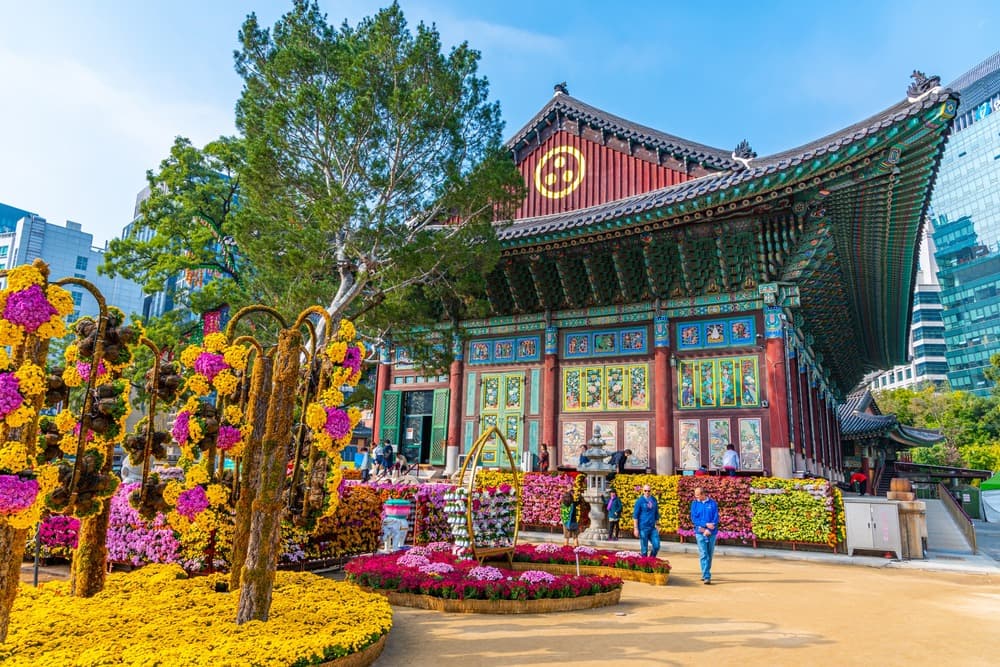
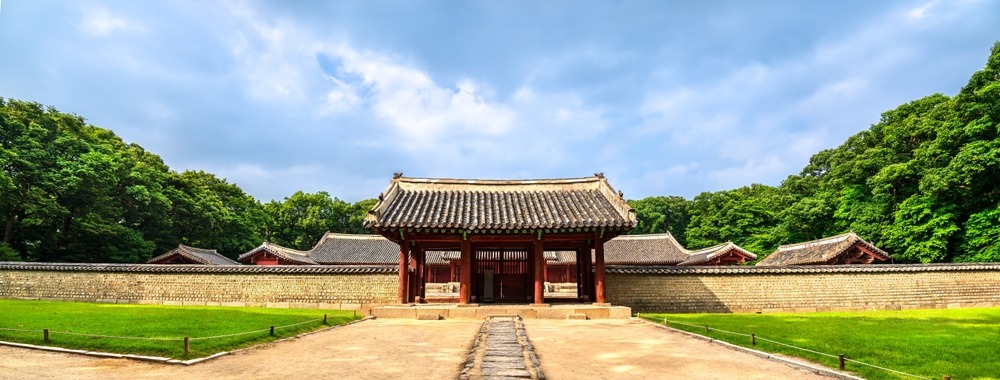
This colourful pavilion houses the four ritual instruments: the Brahma bell, the Dharma drum, the cloud gong and the wooden fish. The monks play them before morning and evening chants. Each instrument is symbolically associated with the salvation of a category of beings: those of the earth, sea, sky and space. If your visit coincides with these times, you can attend the ceremony from the courtyard.
The Geuknakjeon
Dedicated to Amitabha, this pavilion is also called the "hall of infinite life". Inside, ten statues represent the judges who decide, according to tradition, the destination of the soul between paradise and hell after death.
The reliquary stupa
A stupa contains a relic of the Buddha given by the King of Thailand to the monk Anagarika Dharmapala (1864-1933), who subsequently deposited it at Jogyesa. This relic makes the temple an important place of pilgrimage for Korean Buddhists.
Practical information
- Access: free entry, open during daytime all year round.
- Dress code: shoulders and knees covered recommended, especially in the pavilions. Remove your shoes before entering the Daeungjeon.
- Behaviour: silence inside pavilions, photos without flash, do not turn your back to statues when leaving.
- Duration of visit: allow 30 minutes to 1 hour to tour the compound, longer if a ceremony is taking place.
- Templestay: Jogyesa offers a monastic stay programme (meditation, meals, chants) open to foreign visitors, with prior registration. Options range from a few hours to several days.
When to visit
The temple is open year-round, but certain periods are particularly active:
- Spring – Buddha's Birthday (May): celebrated between Jogyesa and Bongeunsa and along Jongno Street. This festival is registered as Intangible Cultural Asset No. 122 and traces its origins to the Unified Silla. The temple courtyard is covered with thousands of lotus lanterns.
- Lotus Lantern Festival (Spring): listed as UNESCO Intangible Cultural Heritage, it also commemorates the Buddha's birthday with a large night parade through the streets of Seoul.
- Lotus Festival: 7th day of the lunar calendar (Summer).
- Chrysanthemum Festival: 15th day of the lunar calendar (Autumn), the courtyard fills with floral displays.
- Dongji: 31st December, winter solstice celebration with an offering of red bean porridge (patjuk).
How to get there
By metro
Two stations serve the temple:
- Jonggak (Line 1, Exit 2): approximately 200 metres on foot. Walk towards the pedestrian crossing, cross it and continue to the access street on the left.
- Anguk (Line 3, Exit 6): approximately 100 metres. Head to the pedestrian crossing in front of the Dongdeok Gallery, cross it, turn left, and the access street is on the right.
By bus
Lines 109, 151, 162, 172, 401, 406, 606, 704, 1020, 7022, 5000A, 5000B, 5005, 5500-2, 9000, 9200 and 9401 stop nearby.
Nearby attractions
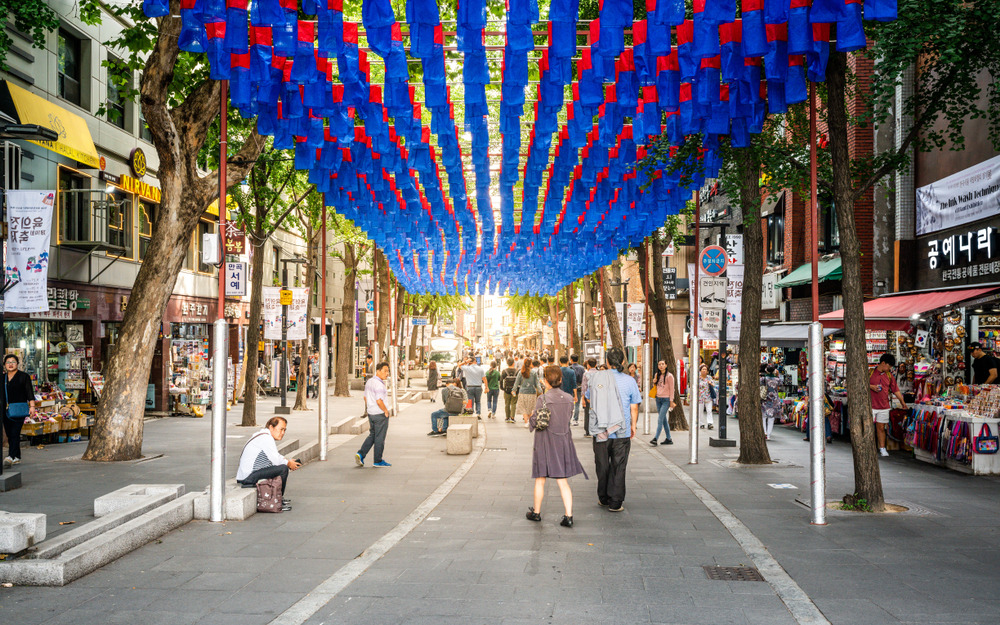
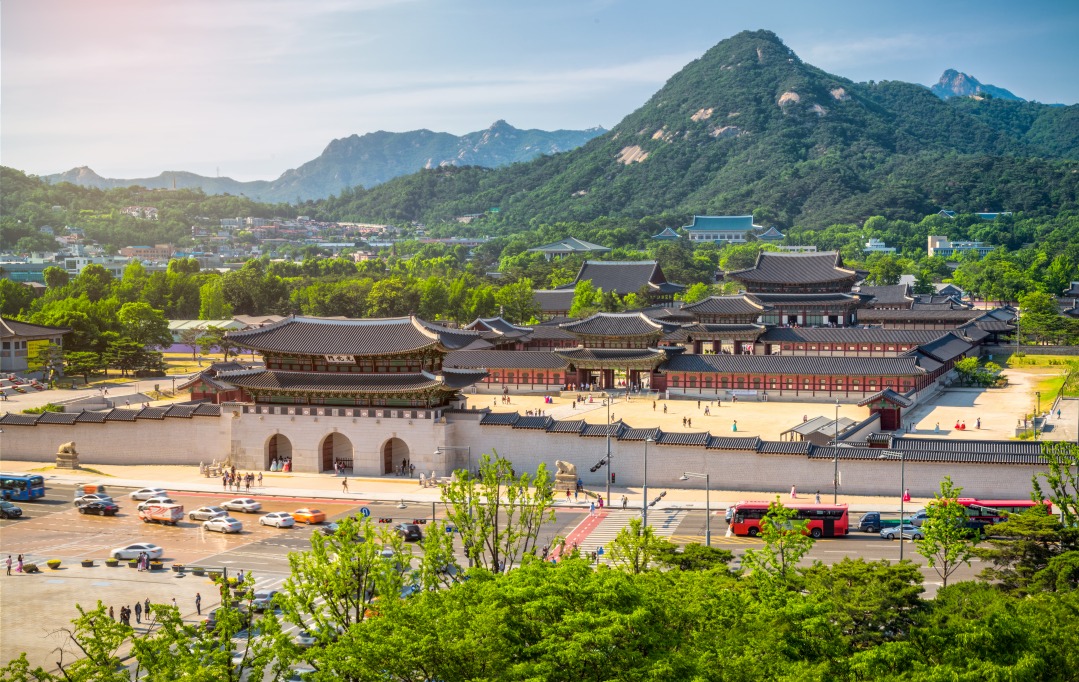
Jogyesa is ideally located for a day of sightseeing in central Seoul. Within walking distance, the Insadong district concentrates galleries, traditional tea houses and craft shops. Gyeongbokgung Palace and the Bukchon hanok village, nearby, complement a half-day dedicated to the heritage of the Joseon dynasty. To further explore Korean Buddhism, you can cross the city to reach Bongeunsa Temple, another major hub of the Jogye Order, or plan an excursion to Haeinsa Temple which houses the Tripitaka Koreana.
Frequently asked questions
Frequently asked questions
Yes, access to the temple is free. Only specific programmes such as Templestay or paid workshops require paid registration.
Yes. The morning and evening chants, preceded by the four instruments of the Beomjongru, are open to the public. Keep your distance from the monks, maintain silence and remain seated or standing discreetly.
30 minutes to 1 hour is sufficient to tour the pavilions and observe the classified trees. Add extra time if you attend a ceremony or if your visit falls during a festival.
May, around Buddha's Birthday, offers the most spectacular display with lotus lanterns. Autumn (Chrysanthemum Festival) is also a privileged time for floral displays.
Yes, programmes ranging from a few hours to several days are open to foreign visitors: Seon meditation, monastic meals, lantern making. Registration is required in advance.
Plan your trip
Jogyesa Temple fits naturally into a cultural itinerary in Seoul, which can be extended with the country's mountain temples. To build your customised trip, consult our tours in South Korea.
Nearby
Interested in this visit?
We can include it in your personalised itinerary.