Jusangjeolli Cliff
Jusangjeolli Cliff
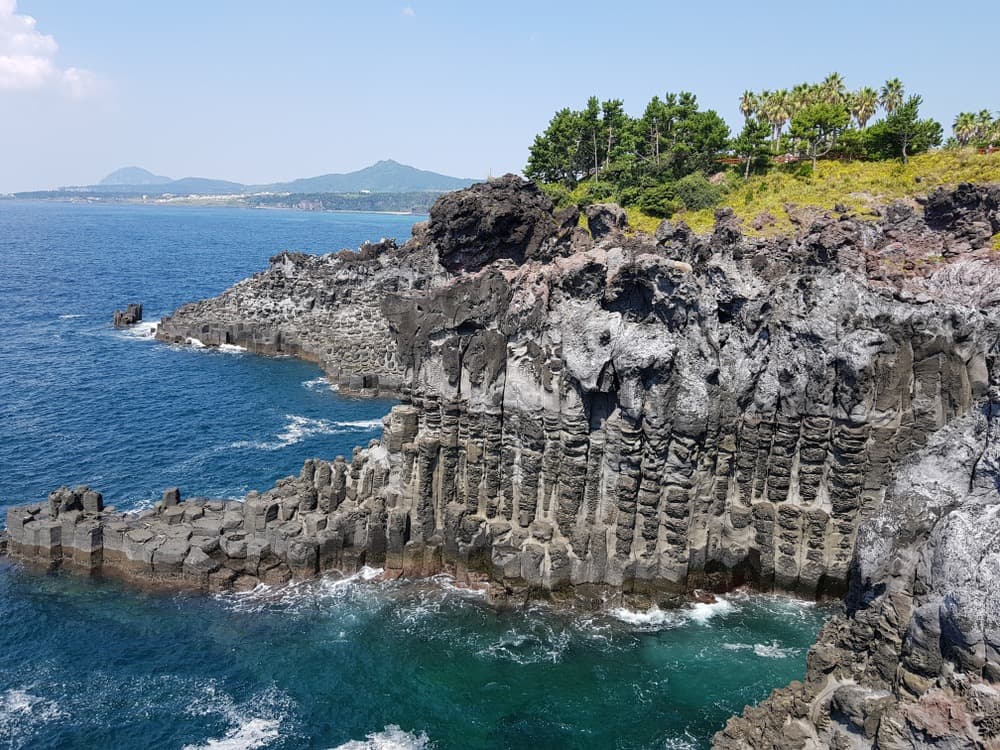
On the southern coast of Jeju, Jusangjeolli Cliff showcases hexagonal basalt columns rising 20 meters high—remnants of Mount Hallasan's volcanic activity.
On the southern coast of Jeju Island, roughly 600 meters south of Depo-dong, Jusangjeolli Cliff aligns hexagonal rocky pillars along the Jisatgae shoreline. These basalt columns, reaching heights of up to 20 meters, form one of the most striking geological signatures of this volcanic island.
Why Visit Jusangjeolli Cliff
The site offers rare testimony to the volcanic phenomena that shaped Jeju. The basalt columns, almost geometrically perfect, are compared to the Giant's Causeway in Northern Ireland. Access is brief and well-maintained: a trail winds through a pine forest to reach an observation platform overlooking the waves.
The appeal is twofold: geological first, then scenic, with a rocky front animated constantly by tides and swell. The site has been designated natural monument no. 443 since 2005, making it a valuable educational landmark for understanding Jeju's volcanic history.
History and Geological Formation
Jusangjeolli Cliff formed between 250,000 and 140,000 years ago during eruptions of Mount Hallasan, when lava flowed all the way to the coast. When molten lava came into contact with water and air, it contracted as it cooled, fracturing the rock into regular vertical columns.
Most pillars display a hexagonal cross-section, though some adopt cubic or pentagonal forms. Tightly packed together, they appear hand-carved, yet they result entirely from the physics of cooling.
Locally, these columns are called "Jisatgae Rocks," named after the area's former designation. Their official recognition as natural monument no. 443 in 2005 confirmed their scientific and heritage value.
What to See and Do
- The column front: the main section, observable from an observation platform perched along the cliff's edge.
- Waves at high tide: foam crashing against the pillars is particularly spectacular in rough seas.
- Line fishing: practiced by some visitors at high tide, from sections accessible via the trail.
- The access pine forest: a short wooded walk between the parking area and the cliff, pleasant and shaded.
When to Visit
The site is accessible year-round. Spring (April–May) and autumn (October–November) offer the most stable conditions, with mild temperatures and good visibility. Summer is more humid and exposed to typhoons, which can make coastal access risky. Winter is cool and windy, but bright.
Tides play an important role: at high tide, water strikes the pillars directly, making the scene more dramatic. At low tide, you can better see the base of the columns. Check local tide schedules before your visit.
Practical Information
- Visit duration: allow 30 minutes to 1 hour on-site, including the access trail.
- Admission: modest entry fee with reduced rates for children.
- Hours: daytime access, generally from morning through late afternoon. Verify by season.
- Accessibility: short trail but can be slippery after rain; closed-toe shoes recommended.
- Safety: stay on marked platforms, especially in rough seas.
How to Get There
The site is accessible by taxi from Jungmun or Seogwipo. By public transport, two main options:
- From Jeju Intercity Bus Terminal: Jungmun express bus, approximately 60 minutes, exit at "Jungmun Tourism Complex," then short walk or taxi.
- From Jeju International Airport: limousine bus no. 600, approximately 50 minutes, stop at "International Convention Center."
A parking area is located at the site entrance for those renting a vehicle, the most convenient way to explore Jeju as a whole.
Nearby Attractions
The cliff fits easily into a day exploring southern Jeju:
- Jungmun Tourism Complex and its beaches, just minutes' drive away.
- Cheonjeyeon Waterfall, in the same area.
- Daepo Port, departure point for fishing and seafood tasting.
To extend your South Korea itinerary, consider coastal stops like Haeundae Beach in Busan, or historical sites such as Hwaseong Fortress. Buddhist heritage enthusiasts will appreciate Magoksa Temple or Haeinsa Temple.
Frequently Asked Questions
Frequently asked questions
Plan Your Trip
Jusangjeolli Cliff fits naturally into a circuit around Jeju and southern South Korea. To build a custom itinerary incorporating volcanic sites, coastlines, and historic cities, explore our South Korea travel ideas.
Nearby
Interested in this visit?
We can include it in your personalised itinerary.