Hwaseong Fortress
Hwaseong Fortress
Just 30 km south of Seoul, Hwaseong Fortress in Suwon stretches 5.7 km of 18th-century ramparts, listed as a UNESCO World Heritage site.
Hwaseong Fortress dominates the city of Suwon, roughly thirty kilometers south of Seoul. Built in the late 18th century under King Jeongjo, it extends nearly six kilometers of ramparts punctuated by monumental gates, watchtowers, and a beacon tower. Inscribed as a UNESCO World Heritage site in 1997, it exemplifies a pivotal moment in Korean military architecture, where traditions of the Joseon dynasty and technical innovations converge.
Why visit Hwaseong Fortress
Hwaseong stands apart from most East Asian fortifications through its design that follows the terrain: the walls rise where the ground is flat and descend on hillsides, integrating the surrounding hills into the defensive system. This logic of military urban planning makes it a recognized case study, distinct from Chinese or Japanese models.
The visit combines several attractions:
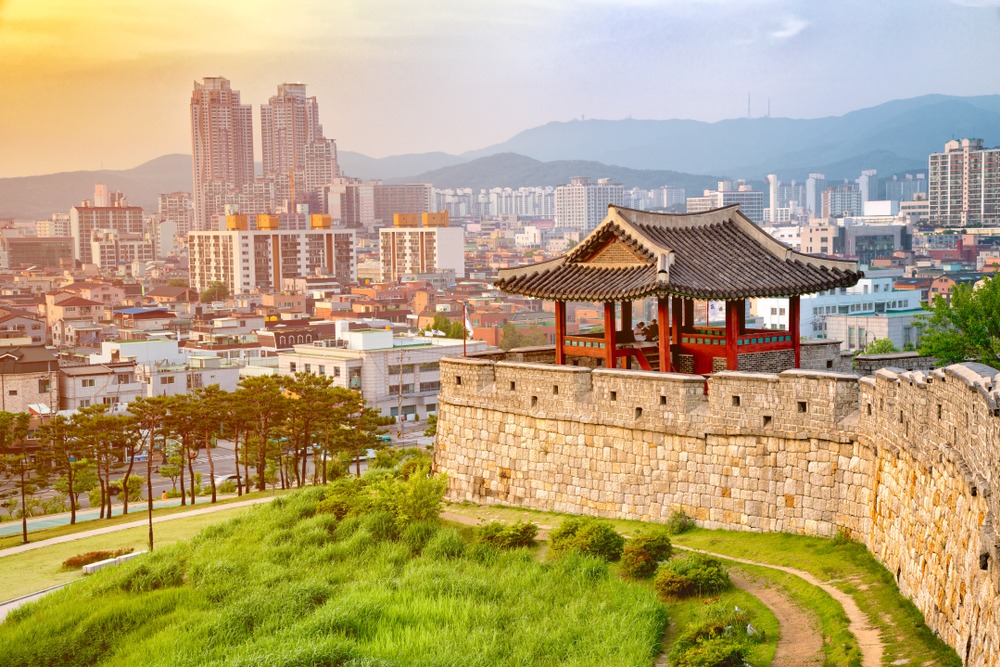
- a complete walk along the ramparts, with panoramic views over Suwon;
- four monumental gates and roughly fifty military structures (towers, platforms, guardhouses);
- a dedicated museum that contextualizes the site within the political history of the Joseon dynasty;
- a UNESCO site still woven into a living urban landscape, rather than preserved as a static archaeological park.
History of the fortress
The site's history is inseparable from King Jeongjo and his father, Prince Sado. The latter was executed on the orders of King Yeongjo, his own father, for disobeying a command to commit suicide. Upon becoming king, Jeongjo undertook the construction of Hwaseong between 1794 and 1796, both as a tribute to this father and to establish in the region a new political center designed to strengthen royal authority against court factions.
The plans were entrusted to Jeong Yak-yong, a leading scholar and reformer, who mobilized innovative construction techniques, including pulleys and cranes that facilitated the handling of stone blocks. The fortress was completed in less than three years, a remarkable achievement for a work of this scale.
The site witnessed significant ceremonies, including the royal visit of 1795, extensively documented in archives and presented today at the Hwaseong Museum. Damaged during the Japanese occupation and later during the Korean War, the fortress underwent successive restoration campaigns beginning in the 1970s, drawing on the original, exceptionally detailed plans.
What to see on site
The ramparts
The enclosure wall measures 5.74 km in length, with a height varying from 4 to 6 meters depending on the topography. It is possible to walk the entire circuit; the route alternates between flat sections through the city and climbs over the surrounding hills.
The four main gates
- Janganmun (north): the principal gate, largest of the four, part of the original structure that survived the destructions;
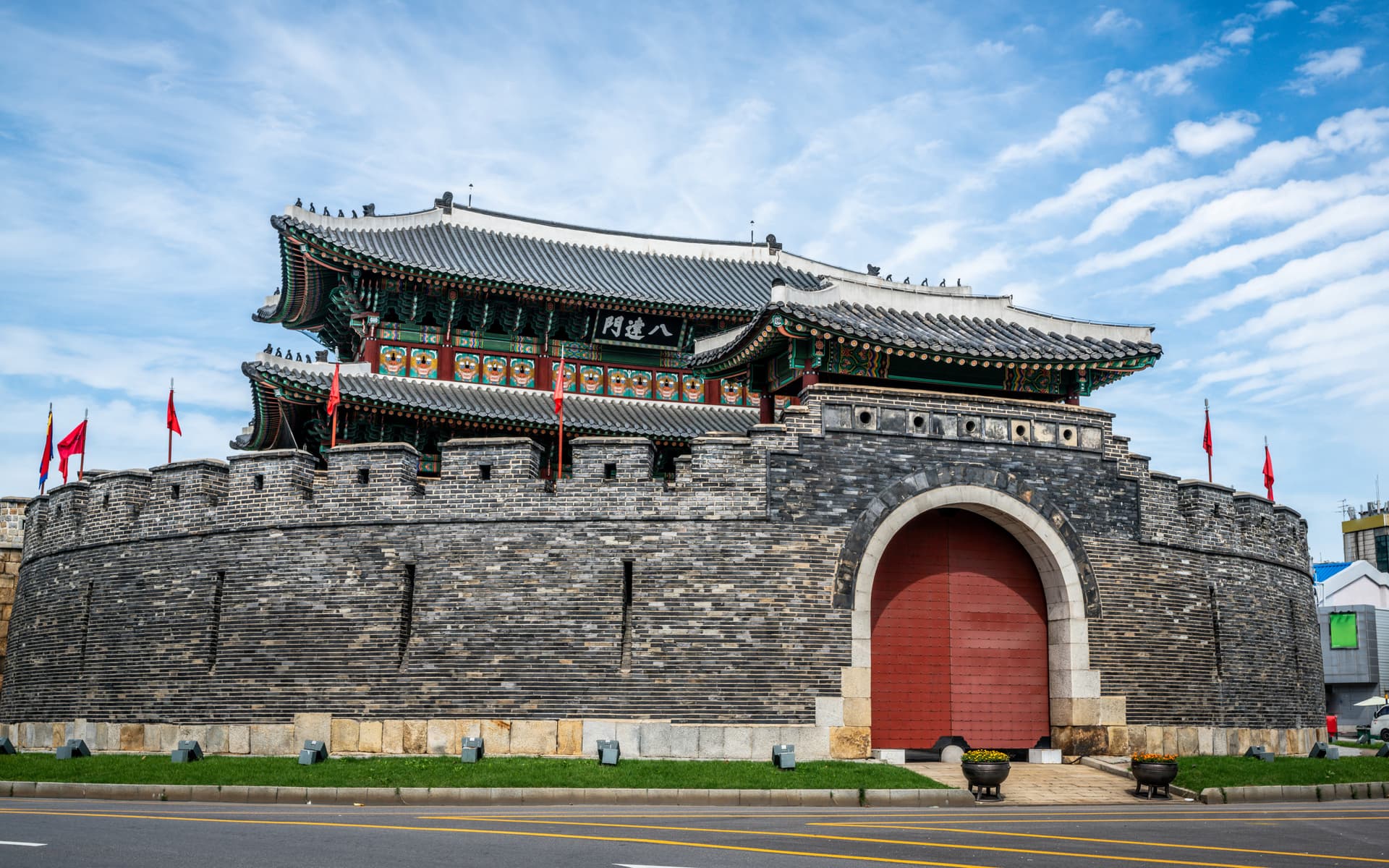
- Paldalmun (south): destroyed by fire during the Korean War, restored in 1975;
- Hwaseomun (west);
- Changnyongmun (east).
The two-story pavilions of the northern and southern gates, with their curved roofs and meticulous stonework and timber framing, recall Seoul's Namdaemun gate. Each gate is surrounded by small structures serving as guardhouses.
Towers, platforms, and beacon tower
The fortress originally contained 48 structures; seven have disappeared through flooding, warfare, and time. What remains includes a sluice gate, secret doors, observation towers, platforms for guards and archers, corner towers, and a beacon tower.
The two three-story watchtowers are pierced with slots for firearms and topped with pavilions. The beacon tower has five chimneys used to transmit signals by fire or smoke:
- 1 chimney lit: peace;
- 2: enemy in sight;
- 3: imminent attack;
- 4: invaders in the city;
- 5: battle engaged.
Hwaseong Museum
Adjacent to the fortress, the museum features two permanent exhibitions. The first traces major events related to the site, including the royal visit of 1795. The second documents the construction of the citadel and Suwon's urban evolution. A dedicated children's area enhances the visit.
Practical information
- Duration of visit: allow 2 to 4 hours to walk the ramparts and visit the museum. A complete tour at a moderate pace takes roughly 2.5 hours.
- Admission: a modest entrance fee grants access to the enclosure; a combined ticket includes the museum and Hwaseong Haenggung Palace. Parts of the ramparts are freely accessible; paid admission applies to the main structures.
- Opening hours: daily during daylight hours. Check seasonal hours before your visit, as they vary between summer and winter.
- Accessibility: walking the ramparts involves stairs and elevation changes; wear suitable footwear.
- A small tourist train connects the main points of interest for visitors wishing to avoid the full walk.
When to visit Hwaseong
The site can be visited year-round, but comfort during the walk varies greatly by season.
- Spring (April–May): mild temperatures, cherry blossoms along the ramparts, a highly favored period.
- Autumn (October–November): clear skies, colorful foliage, ideal conditions for photography.
- Summer (July–August): humid heat and monsoon showers, best avoided for the full walk.
- Winter: dry cold, occasional snow, clear light but potentially slippery surfaces in places.
The Hwaseong Cultural Festival, held each autumn, features historical reenactments and costumed parades.
How to get there
Suwon is easily reached from Seoul:
- Subway: Line 1 to Suwon Station, then local bus or taxi to the fortress gates;
- Train: direct trains from Seoul Station;
- Bus 1007 from Jamsil Station;
- Bus 3000 from Gangnam Station.
Once in Suwon, several local bus lines serve the four fortress gates from the railway station.
What to see nearby
The fortress naturally fits into a day exploring Suwon, which also hosts Hwaseong Haenggung Palace, a temporary residence of Joseon kings during their visits. To extend a cultural itinerary across South Korea, you can combine Hwaseong with other major sites such as Magoksa Temple or Haeinsa Temple, which preserves the Tripitaka Koreana. In Seoul itself, the Itaewon district offers contemporary contrast to Suwon's historical atmosphere.
Frequently asked questions
Frequently asked questions
Allow 2 to 4 hours depending on your pace. The complete rampart circuit requires about 2.5 hours of walking, plus a visit to the Hwaseong Museum.
Part of the ramparts can be walked freely, but access to the main structures and the museum requires admission at a modest fee. Combined tickets are available with Hwaseong Haenggung Palace.
The easiest way is Subway Line 1 to Suwon Station, or a direct train from Seoul Station. Buses 1007 (from Jamsil) and 3000 (from Gangnam) also serve Suwon.
Spring (April–May) and autumn (October–November) offer the best conditions, with mild temperatures and landscapes enhanced by cherry blossoms or autumn foliage.
The site was inscribed for the quality of its military design, the use of innovative construction techniques for its era, and exceptional archival documentation that enabled faithful restoration.
Prepare your journey
Hwaseong Fortress provides an excellent entry point into the history of the Joseon dynasty, to be integrated into a broader cultural circuit. To build a custom itinerary combining Seoul, Suwon, and the country's major sites, consult our South Korea trips.
Interested in this visit?
We can include it in your personalised itinerary.