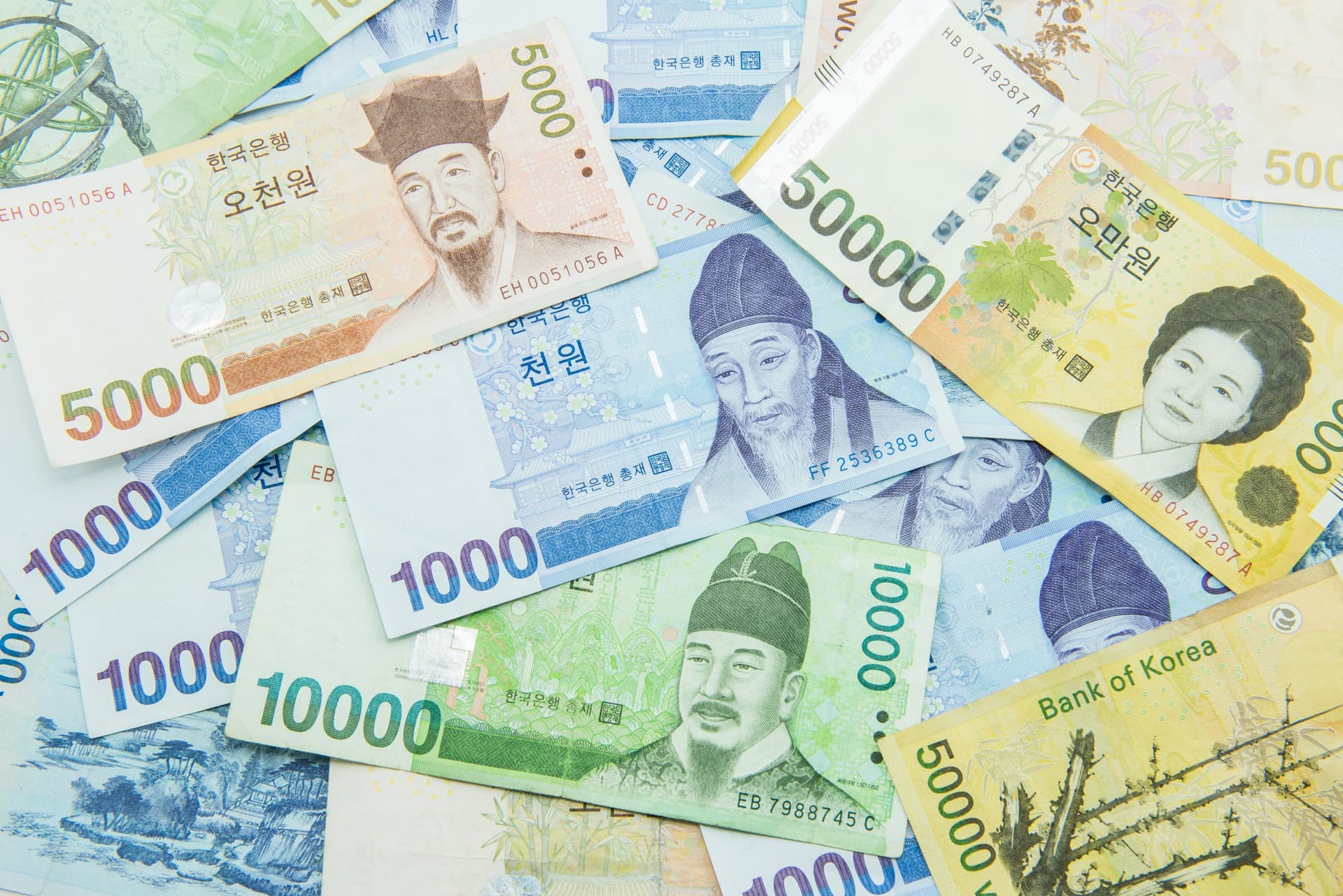
South Korean Currency
The Won is the monetary unit of South Korea since 1962, replacing the hwan which had been in circulation from 1953 to 1962. The word won is related to the Japanese yen and Chinese yuan, as all three were originally written with the same character meaning "round".
The Won is the monetary unit of South Korea since 1962, replacing the hwan which had been in circulation from 1953 to 1962. The word won is related to the Japanese yen and Chinese yuan, as all three were originally written with the same character meaning "round".
History of South Korean Currency: The "Won"
In 1945, shortly after the departure of the Japanese and the arrival of the Americans, the first South Korean "won" replaced the Korean yen while maintaining a parity of 1 won to 1 yen. At that same time, the won was pegged to the U.S. dollar, but unfortunately the latter suffered rapid devaluation, leading immediately to its replacement by the hwan in 1953. At that time, you could exchange 100 won for just 1 hwan. It was not until June 1962 that the current "won" currency regained its value at the rate of 10 hwan to 1 won. Upon its introduction in 1962, the won was valued at 125 wons to 1 dollar.
Since then, the South Korean won has officially floated freely following an agreement signed with the International Monetary Fund in December 1997, during the Asian economic crisis. Struck by this economic crisis, the won lost more than half its value, dropping from 915 won to 1 dollar in 1997 and continued to depreciate thereafter. Currently, 1 won is equivalent to approximately 1,120 wons to 1 dollar.
Payment Methods During a Trip to South Korea
You can exchange currency and traveler's checks at exchange offices and international hotels. You can also use your card at major shopping centers and certain hotels. Nevertheless, it is recommended to always carry cash with you to settle restaurant bills, admission fees, and other daily expenses.
Exchanging and Withdrawing Won
To obtain local currency, we simply recommend withdrawing cash from a bank's ATM. They generally accept international debit and credit cards such as Visa or MasterCard. The exchange rate is often better this way. However, be aware of fees charged by the local bank for each withdrawal in addition to those from your own bank, so avoid making multiple withdrawals.
Taxes and Tipping
You do not need to tip in South Korea. However, at certain hotels and major restaurants, you should be aware that a 10% service charge is automatically added to your bill.
A Few Tips for Using Your Debit Card
Before using your debit card, you must absolutely inform your bank of your upcoming trip to South Korea. Since it is not yet a widely visited destination, your bank may be concerned and block all transactions (which is possible). Also, inquire about any fees incurred by withdrawals made "outside the euro zone". Additionally, in South Korea, you do not need to enter your PIN code. For larger amounts, you may be asked to sign on a digital pad. At the moment the cashier inserts your card into the machine, the amount is never displayed. Always verify the amount you need to pay on the receipt given to you after payment. If you are not provided with a receipt, ask for at least a receipt slip.