The Demilitarized Zone (DMZ): A closer look at the border between North and South Korea!
Whether you're a history enthusiast, an adrenaline seeker, or simply curious, the DMZ should be on your list of must-see destinations during your trip to South Korea.
Whether you're a history enthusiast, an adrenaline seeker, or simply curious, the DMZ should be on your list of must-see destinations during your trip to South Korea. This famous demilitarized zone separates North Korea from South Korea. It has become increasingly popular with travelers because it offers insight into the history of these two nations. But more importantly, the DMZ allows visitors to get as close as possible to North Korea. Read on to discover more about this guided tour that will mark your passage between the two Koreas…
What is the DMZ in South Korea?
A buffer zone between the two Koreas
Before the creation of the DMZ, the Korean Peninsula was marked by forty years of Japanese occupation—which ended at the close of World War II in 1945. After Japan's defeat, Korea was divided into two distinct zones: the North (controlled by the Soviets) and the South (controlled by the Americans).
Despite several reunification attempts, each zone proclaimed its own republic, thus giving birth to the two Koreas... They are separated by the demarcation line known as the "38th parallel."
On July 27, 1953, this famous demilitarized demarcation line was established to prevent military conflict between North and South. The DMZ is a symbol of division, but also a representation of a desire for peace between the two nations. Indeed, it was created following the announcement of the Panmunjom Armistice on March 23, 1953.
Since then, the border has become a no man's land, where nature has reclaimed its territory. Stretching 248 km long, the DMZ separates the two countries with a width of 4 km, which corresponds to a neutral zone. Beyond this famous frontier, the agreement also provided for the creation of a joint security area, the "Joint Security Area" (JSA), which is placed under UN control.

A demilitarized zone
Paradoxically, this demilitarized zone is an ultra-protected site! Indeed, the term "demilitarized" is primarily legal: it designates an area where military forces are officially prohibited (i.e., a no-combat zone), but where surveillance and restrictions are very rigorous for security reasons.
The latter is particularly high along both sides of the border—along the demarcation line (MDL - Military Demarcation Line). Despite tensions between the two Koreas, the DMZ remains a secure tourist destination, attracting approximately 100,000 visitors each year.
How to visit the DMZ in South Korea?
How to get to the demilitarized zone?
There are two tourist zones: the Paju DMZ (the closest to Seoul and the most visited) and the Cheorwon DMZ (the least touristy and most expensive, as it's further from the capital).
Both sites are accessible from South Korea's capital by bus or train (approximately 1 hour to Paju and 2 hours to Cheorwon):
By train, you'll board at Seoul Station and get off at Imjingang or Dorasan, depending on schedules.
By bus, departures are from several neighborhoods (depending on tour operators).
Be sure to book your tour at least 5 days in advance (online or directly through a travel agency).
Guided tour is mandatory
Although the DMZ poses no danger to visitors, it is a sensitive site that can only be visited with a guide. For this reason, visitor access is subject to an "organized tour." Furthermore, only certified tourism agencies are authorized to enter the DMZ.
Also for security reasons, each visitor's passport is checked upon arrival. Most often, these passport checks occur before boarding the bus. If you arrive by train, you'll need to follow a marked pathway (where your documents will also be checked) and walk to a specific point, where an access authorization pass will be issued. After that, visitors are divided into buses to reach the heart of the DMZ.
A highly secure location: rules to follow
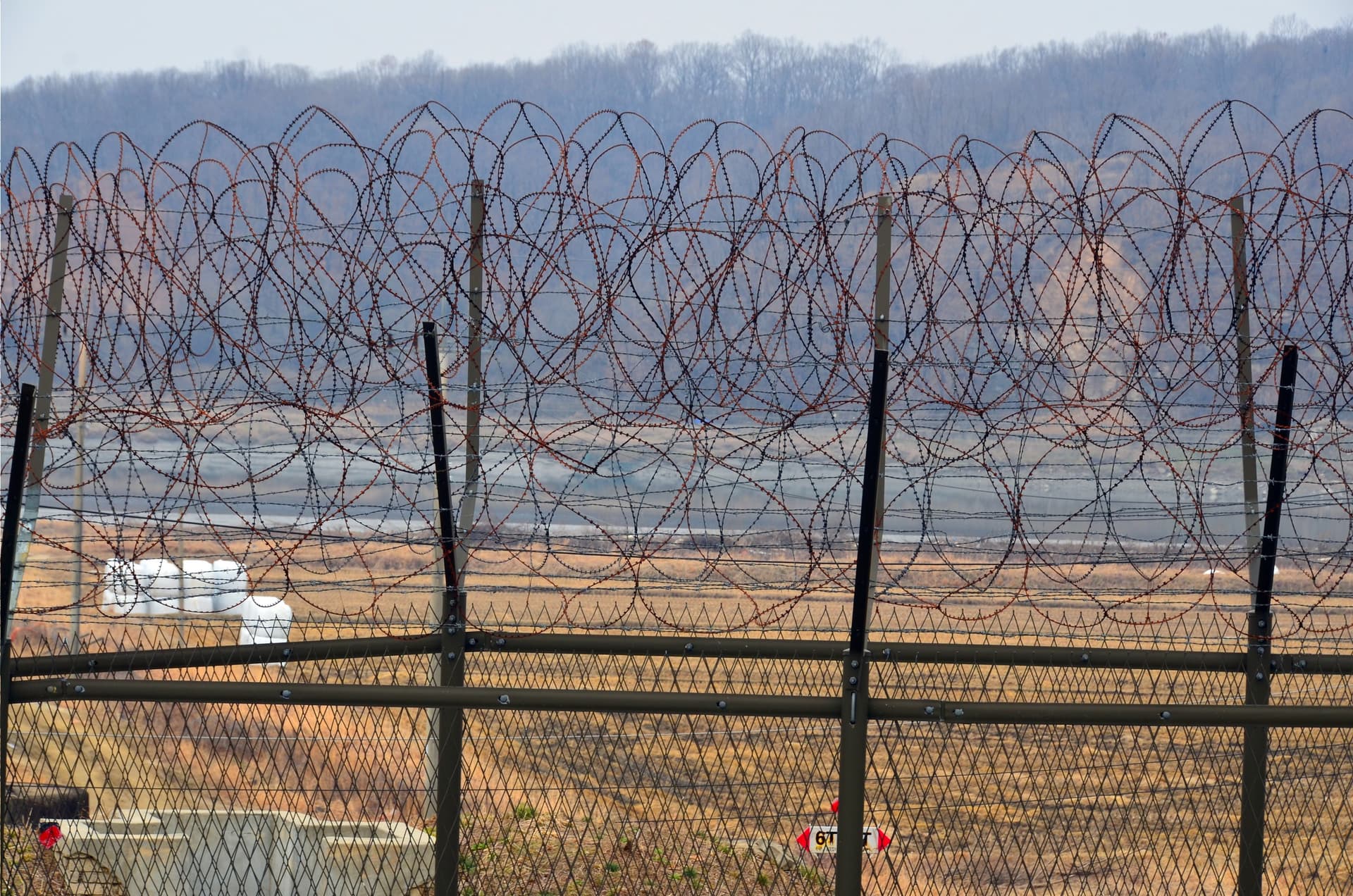
Given that the zone is still scattered with mines, barbed wire, and alert soldiers, it's impossible to visit the DMZ on your own. During your visit to the DMZ, your guide will explain the role of this demilitarized zone as well as that of the joint security area. You'll receive a historical overview of the Korean War from its beginnings to today. For a successful visit, you must observe several rules:
Always keep your passport with you (a check will be conducted by your agency upon departure from Seoul regardless). But loss can happen... To avoid trouble, scan your documents and send them to your email so you can prove your identity at any time.
Do not take photos in certain areas (where soldiers are stationed). Even though some don't always respect this rule: it's strongly discouraged to photograph restricted zones. Ideally, always ask your guide for confirmation before taking out your camera!
Respect the required dress code. To enter the zone, forget flip-flops, sandals, tank tops, shorts, and skirts. Cover your shoulders and knees! If you don't follow this rule, entry to the JSA may be refused (should it reopen one day—see later in the article).
Keep in mind that the visit is prohibited for children under 10 years old!

How long does a DMZ visit in Korea take?
Originally, the visit could last a half-day (DMZ only) or a full day (DMZ + JSA). But following an incident that occurred in July 2023, JSA visits have been suspended.
While rules had already begun to tighten during the Covid-19 health crisis, they became stricter following the escape attempt by American soldier Travis King (stationed in South Korea) who crossed the demarcation line to defect to North Korea (and flee disciplinary sanctions awaiting him...).
This incident revived tensions between the two Koreas. On one side, North Korea strengthened its military presence in the zone. On the other, South Korea restored several guard posts. These decisions led to the prolonged closure of the JSA to the public.
Depending on your travel agency, you can also include visits to other DMZ tourist sites such as the Bridge of Freedom, Dorasan Station, Infiltration Tunnels 2, 3, or 4, Tongil Hill, and other observation points where you can glimpse North Korean life from a distance using telescopes, or the DMZ Museum…
The price of a DMZ visit depends on its duration, but also on the number of sites you wish to visit within the DMZ. A full day costs on average €50 per person (entrance + round-trip bus included). The price then varies depending on meal costs and any other options offered by your organization.
What to see in the DMZ?
Infiltration tunnels
The DMZ has several tunnels on its territory (four of which were discovered by South Korean military personnel between 1974 and 1990). Among them, the 3rd Infiltration Tunnel appears to have been dug for a military attack. Over 1.6 kilometers long and situated approximately 70 meters underground, visitors can travel through it (while wearing a helmet).
Dora Observatory
Dora Observatory is an important DMZ location as it allows visitors to view North Korea through binoculars and an unobstructed view of the other side of the border. In the distance, you can notably see the village of Kijong-dong…
This village is considered a propaganda village, as it was built in 1950 to give a "good image" of North Korea. This Potemkin village (facade only) is the only one visible from South Korea.
According to North Korea, 200 farmers reside in Kijong-dong, but evidence suggests the village is actually empty (with houses and neighborhoods that turn lights on and off at fixed times...).
Camp Bonifas
Camp Bonifas is a military base located just south of the DMZ, jointly managed by South Korean and American soldiers. This camp houses the Security Battalion of the United Nations Command, responsible for enforcing the armistice agreement signed in 1953 between the two Koreas.
The camp is named after an American captain killed during the "Poplar Incident" that occurred in 1976—clashes between North Korean soldiers and American and South Korean soldiers over the pruning of that poplar tree... It's also the departure point for visits to the JSA (when the zone is open to the public).
Its particularity? Camp Bonifas has a golf green surrounded by minefields! This mini hole, set up by American soldiers (with a touch of dark humor) has never really been used.

Mines… and wild animals!
As you've gathered, visiting the DMZ means learning more about the incredible history of Korea and its division. It's also getting a dose of adrenaline during your trip to South Korea, in a site where tensions remain palpable. Beyond historical tours, the DMZ is also an opportunity for a nature retreat…
Despite numerous mines, this lush no man's land has become a wildlife sanctuary, where many animal species thrive. Since public access to this zone was prohibited for decades, wildlife and flora have been able to develop there in excellent conditions, far from human hustle and bustle. If you're fortunate, you might catch a glimpse of gorals, lynx, or even black bears, migratory birds, and panthers!
Joint Security Area (JSA)
This is where inter-Korean negotiations take place. In other words, it's the only place where the North Korean military and South Korean forces face each other. It's also here that the Military Armistice Commission convenes to enforce the ceasefire agreement. In short, the JSA is the one and only crossing point between North Korea and South Korea!
Following the incidents mentioned earlier and tensions between the two countries, the JSA is currently closed to the public. In 2025, only heads of state can access this zone as part of diplomatic meetings. In 2019, Donald Trump met with North Korean leader Kim Jong-un there.
Imjingak Park
Seven kilometers from the DMZ, you'll find Imjingak Park. This strip of land is located outside the demilitarized zone, in the city of Paju—within the Civil Control Zone (CCZ) limit, between the DMZ and the Civil Control Line (CCL).
The park is a buffer zone, but also a symbolic place dedicated to families separated during the Korean War. It houses several important spots, including:
The Bridge of Freedom (used by prisoners of war to return to the South after the armistice signing).
The memorial fence where you can see thousands of words and messages written on ribbons… It's a space of memory, but also of hope (for reunification). Meetings for separated families are sometimes organized here.
Remnants of a steam locomotive that was destroyed during the Korean War (1950-1953).
Located outside the DMZ, Imjingak Park can be visited without a guide (it's a public park).
Dorasan Station
Dorasan Station is the last railway station in South Korea, just before the border. Although not located within the DMZ, it remains a moving place that evokes the division between the two Koreas. In the hall, you can read a sign in Korean and English: "Not the last station departing from the South, but the first heading North"…

Frequently asked questions
How can I get from Seoul to the DMZ?
To visit the DMZ from Seoul, two options are available: train or tour bus. The train departs from Seoul Station and serves the stations of Imjingang or Dorasan, depending on schedules. The bus, usually provided by an agency (since the tour is obligatorily guided), departs from different neighborhoods, including Myeong-dong. In both cases, the journey takes between 1 and 1.5 hours and leads to the Paju DMZ zone.
Is the Korean DMZ safe?
As a buffer zone between the two Koreas, the DMZ is heavily monitored and is only accessible through a guided tour (after verification of each individual's passport). It is a completely secure place for visitors.
Is the Korean DMZ worth visiting?
Created for political reasons, South Korea's demilitarized zone is a unique place that serves as a geographical and political border with North Korea. Highly touristic, the DMZ is an essential stop that allows you to learn more about the historical past of the two Koreas. It's also an unusual place where history, wild nature, and offbeat spots coexist across 1,000 km².
Frequently asked questions
Yes, it is essential to book your visit at least 5 days in advance, either online or through a travel agency. The DMZ visit is obligatorily guided and spaces are limited. Also remember to bring your passport, which is required to access the site.
No. Since the July 2023 incident involving American soldier Travis King, the Joint Security Area (JSA) has been closed to the general public. In 2025, only heads of state can access it as part of diplomatic meetings. Its reopening has not yet been confirmed.
The Paju DMZ is the zone closest to Seoul (approximately 1 hour away) and the most visited by tourists. The Cheorwon DMZ is further away (approximately 2 hours from Seoul), less touristy, and therefore more expensive. However, it offers a more authentic and less commercial experience.
Yes! Unlike the DMZ itself, Imjingak Park is a public park located 7 km from the demilitarized zone, in the city of Paju. It can be visited freely, without a guide or reservation. You'll find the Bridge of Freedom, a steam locomotive dating from the Korean War, and a moving memorial fence.
Yes, visiting the DMZ is prohibited for children under 10 years old. To access the JSA (when it's open), strict dress code rules also apply: it's forbidden to wear flip-flops, sandals, shorts, skirts, or tank tops. Shoulders and knees must be covered.