A Brief History of the "Two Koreas"
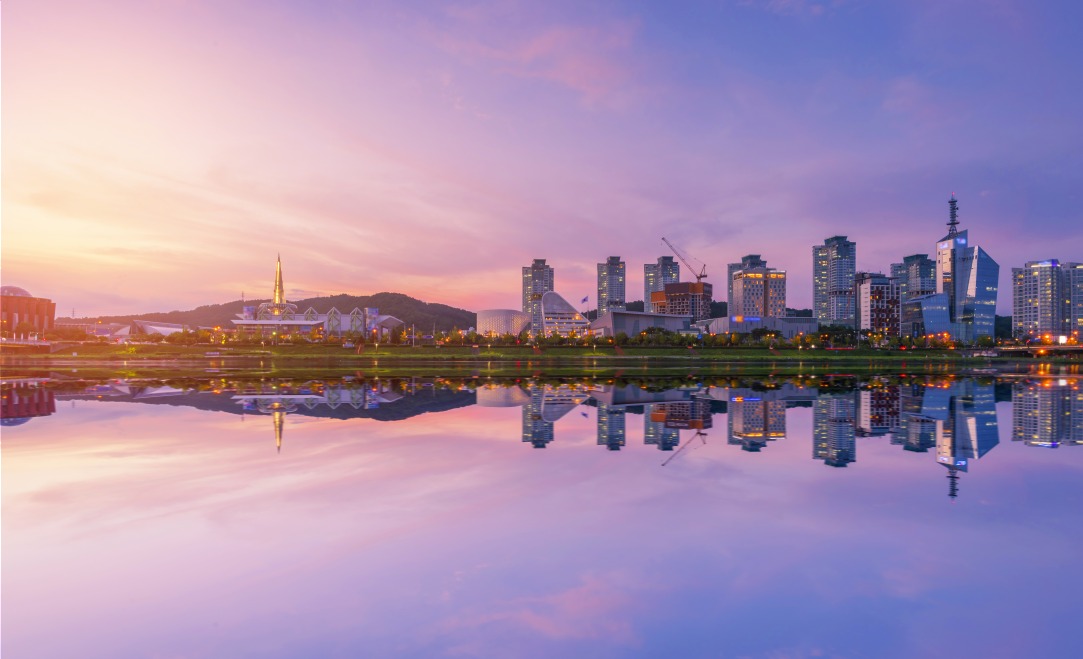
Just as the Seine divides the right and left banks of Paris, the Han River separates north and south Seoul
Just as the Seine divides the right and left banks of Paris, the Han River separates north and south Seoul. For Koreans, the question of north and south is far more sensitive than that of right-wing and left-wing politics in France.
The Division of Two Nations
In 1945, Japanese Emperor Hirohito announced unconditional surrender. The Second World War came to an end at the same time as Japanese colonization of the Han Peninsula (Korea) ended. This sudden liberation after 36 years of Japanese occupation came as many Koreans who had long fought for Korean independence were preparing to establish a new nation.
After the war, the United States, fearing that Korea would become a communist country under the influence of nearby Russia, decided to divide Korea in two by establishing a border along the 38th parallel. Russia settled in the North and the United States in the South. Many large-scale protests calling for the establishment of an independent and unified Korea took place, but Korea was already split in two.
On August 15, 1948, the first president Lee Seung-Man announced the founding of the "Republic of Korea" in the south, and on September 9 of the same year, North Korea's leader Kim Il Sung established the "Democratic People's Republic of Korea" in the north.
The Korean War
On June 25, 1950, at dawn, North Korea suddenly attacked South Korea with the help of Russia. This offensive was so sudden that South Korea's capital, Seoul, was captured in three days. The South Korean army was forced to retreat. Within less than a month, all of Korea was invaded except for the Busan region in the south.
On July 20, 1950, the UN decided to send an army, but victory's fortune had yet to smile on South Korea. American reinforcements nevertheless managed to hold the small perimeter around Busan. On September 15, 1950, General MacArthur, commanding the UN forces, launched a brilliant amphibious invasion behind enemy lines, landing his troops at Inchon, a port city on South Korea's west coast, approximately 40 km west of Seoul. Coordinating their attack, UN forces succeeded in breaking out of the Pusan perimeter.
On September 28, Seoul was retaken, and on the 30th, North Korean forces were pushed back beyond the 38th parallel. However, North Korea, backed by China, continued the war.
On July 27, 1953, after more than three years of deadly fratricidal conflict, the two Koreas finally agreed to suspend hostilities.
After the Horror
Since 1972, negotiations between North and South Korea for peace and reunification have continued. In September 1991, North and South Korea were simultaneously admitted to the United Nations.
In June 2000, South Korea's president Kim Dae-Jung met with North Korea's leader Kim Jong-Il in Pyongyang, the North's capital. It was a historic summit where the heads of state of the two Koreas notably signed an agreement allowing families divided by the war to reunite after more than 30 years of separation.
We, South and North Korea, speak the same language.
We have the same ancestors.
We have the same traditions.
We are one family.
Frequently asked questions
At the end of the Second World War in 1945, the United States and the Soviet Union decided to divide the Korean Peninsula into two zones of influence, separated by the 38th parallel. This decision, motivated by Cold War tensions, led to the creation of two states in 1948: the Republic of Korea in the south and the Democratic People's Republic of Korea in the north.
The Korean War began on June 25, 1950, when North Korea attacked South Korea. It ended on July 27, 1953, with an armistice, spanning more than three years of conflict. No official peace treaty has been signed to this day, which means the two Koreas are technically still at war.
Yes, the two Koreas share the same language: Korean (한국어 / 조선어). However, decades of separation have resulted in differences in vocabulary, accent, and expressions. Both countries use the same alphabet, Hangul, but certain English loanwords used in the South do not exist in the North.
Yes, the Demilitarized Zone (DMZ) is one of the most popular excursions from Seoul. Located approximately 50 km north of the capital, it is accessible via organized tours that allow you to visit iconic sites such as the Panmunjom village, North Korean infiltration tunnels, and the Bridge of Freedom.
Yes, several must-visit sites allow you to delve into this history. The War Memorial of Korea in Seoul is an exceptional museum dedicated to the Korean War. The Demilitarized Zone (DMZ) offers a unique experience at the border. Imjingak Park and the village of Panmunjom are also powerful places steeped in history.