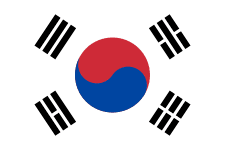
What is the Meaning of the South Korean Flag?
The flag of South Korea, called Taegeukgi, was officialized and came into force three eras before the country's creation on August 15, 1948.
The flag of South Korea, called Taegeukgi, was officialized and came into force three eras before the country's creation on August 15, 1948. Before Japan's annexation of Korea between 1910 and 1945, the Korean Empire, established in 1897, governed the peninsula, uniting south and north. And preceding this ephemeral regime, the Joseon Dynasty (1392-1910) had reigned since 1392 over the East Asian peninsula. It was in 1883 and under this reign that the Taegeukgi was born.
The flag of the Joseon Kingdom (Korea) seems totally different from that of South Korea but presents many common points, such as the presence of trigrams, highly representative of the current Korean symbol.
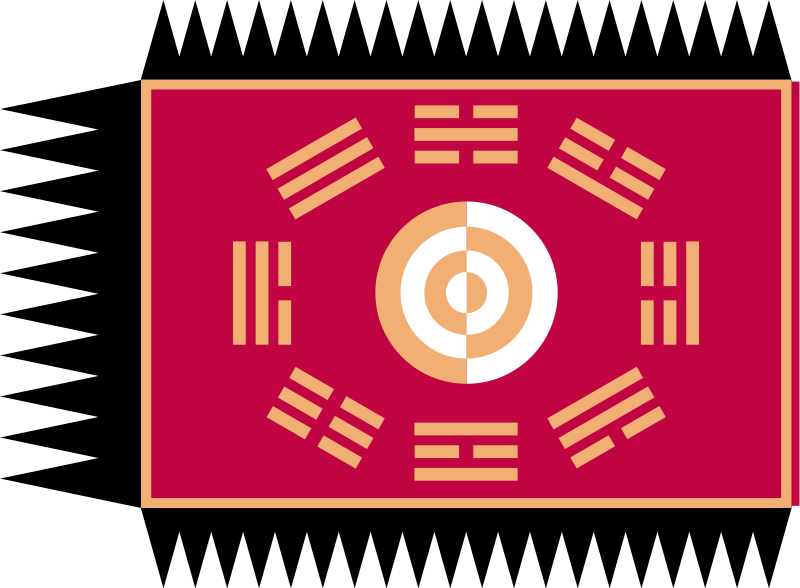
This flag remained in place for centuries, and it was not until 1876 that the question of redesigning the flag was brought to the table.
An Inherent Link with Japan
Things began to take shape within a fortress on the Korean island of Ganghwa. High-ranking Korean and Japanese officials gathered there to sign the Treaty of Ganghwa, better known as the "treaty of friendship" between the two countries. Korea then allowed Japanese citizens to trade in the ports of Busan, Incheon, and Wonsan.
Japanese representatives arrived on the negotiation island brandishing their flags and standards. Aware of the importance of a symbol and national unity, members of the Joseon Dynasty realized their need to unite the country. This characteristic white background of the Japanese flag was also highly symbolic in Korea at that time. This color represented purity and peace. The sight of this delegation proudly brandishing an emblem of pure and unflawed lightness tipped the scales. The dynasty wanted a new flag. It would be the Taegeukgi.
Creation and Meaning
On August 22, 1882, Korean politician Park Yeong-hyo proposed to the government a first pattern of the Korean flag, which became official on January 23, 1883. On a white background, it features in the center the Taijitu, the symbol of yin and yang, colored blue to symbolize the negative forces of yin and red to represent the positive cosmic forces of yang, called Taegeuk in Korean.

In each corner have been drawn the four trigrams, emblems of the four elements: water, air, earth, and fire. The symmetry of the canvas suggests universal harmony to maintain balance: yin opposed to yang, air to earth, and water to fire. This flag became the national symbol of unified South Korea in 1949. Several modifications took place throughout history, notably on January 25, 1950, when the trigrams were reorganized in their current position: air (3 entities in the top left), water (5 entities in the top right), fire (4 entities in the bottom left), and earth (6 entities in the bottom right).
Frequently asked questions
The word 'Taegeukgi' comes from Korean: 'Taegeuk' designates the yin-yang symbol present in the center of the flag, and 'gi' means 'flag'. The Taegeukgi is therefore literally the 'flag of the Taegeuk'.
The four trigrams in the corners of the flag represent the four fundamental elements: air (top left), water (top right), fire (bottom left), and earth (bottom right). Their arrangement suggests universal harmony.
The white background of the Taegeukgi symbolizes purity and peace. This color was already highly symbolic in Korea at the time of the flag's creation in 1883, and its significance remains the same today.
The first pattern of the flag was proposed on August 22, 1882 by politician Park Yeong-hyo. It was officialized on January 23, 1883 under the Joseon Dynasty. Its current form, with the trigrams repositioned, dates from January 25, 1950.
The South Korean flag (Taegeukgi) is white with a yin-yang symbol and four black trigrams. The North Korean flag is very different: it is composed of red, blue and white stripes, with a red star in the center, without any traditional Korean symbols.