Jeondong Cathedral
Jeondong Cathedral
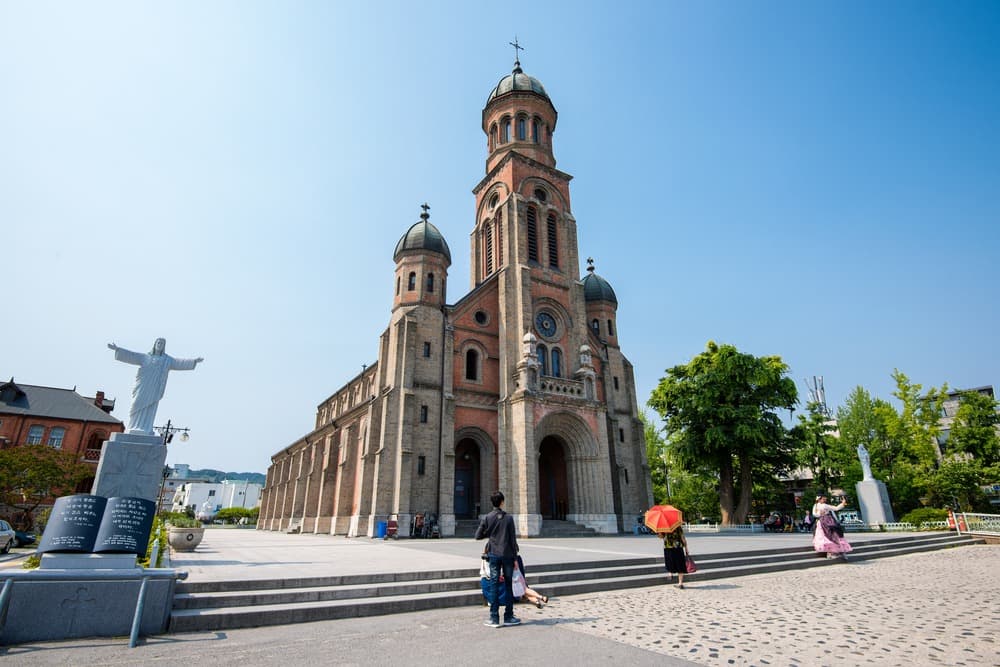
Built between 1908 and 1914 on a site of Catholic martyrdom, Jeondong Cathedral blends Byzantine and Romanesque styles at the entrance to Jeonju's Hanok village.
Designated Historic Site No. 288, Jeondong Cathedral stands at the entrance to the traditional Hanok village of Jeonju, on the very spot where several Korean Catholics were executed during the Joseon dynasty. Built between 1908 and 1914, it marries Byzantine and Romanesque inspirations, and remains one of the city's principal architectural landmarks.
Why Visit Jeondong Cathedral
The building commands attention for several reasons. First, it is a site of remembrance tied to Korea's earliest Catholic martyrs, including Paul Yun Ji-chung and Jacobus Kwon Sang-yeon, executed at the nearby Pungnammun gate on December 8, 1791. Second, it is a work designed by Victor Louis Poinel, the French priest-architect who also designed Myeongdong Cathedral in Seoul—a connection that explains the striking visual kinship between the two structures. Finally, its position at the entrance to Jeonju's Hanok village makes it easy to incorporate into a broader exploration of the city's historic quarter.
History
The land was acquired in 1891 by French priest Baudounet, on the occasion of the centenary of the martyrdom of the blessed Paul Yun Ji-chung and Jacobus Kwon Sang-yeon, executed at this site on December 8, 1791. Construction itself did not begin until 1908 and was completed six years later, during Japanese rule.
The plans were entrusted to Victor Louis Poinel, also the architect of Myeongdong Cathedral in Seoul. Both buildings share the same aesthetic of grey and red brick. The cathedral was initially planned in the immediate vicinity of the Pungnammun gate, the site of persecution, before being relocated to its current location to allow for expansion. Some of the bricks used came from materials recovered from Jeonjueupseong, the fortified city destroyed by the Japanese; the cornerstone itself is said to have come from this citadel.
During the Korean War, the building was occupied by North Korean military forces and converted into a truck garage, while the adjoining convent served as a telegraph office. During the most recent restoration campaign, approximately 4,000 damaged bricks were replaced out of the 140,000 that make up the exterior wall.
The cathedral is attached to the Diocese of Jeonju (Dioecesis Ieoniuensis) and is also known as Jeondong Church of Francis Xavier.
What to See
Exterior Architecture
The building features a rectangular plan and marries Byzantine and Romanesque styles. Three Byzantine-style bell towers crown the structure, and the arrangement of grey and red bricks forms the building's visual signature. Several brick annexes complete the site, maintaining the same tonal harmony.
The Interior
Inside, the arched ceilings converge in places to form crosses. The space is austere and remains accessible to visitors outside of services. It is best to avoid Mass times to enjoy the cathedral without interrupting worshippers.
The Martyrs' Memorial
In front of the cathedral, a Christ statue and a monument bearing the inscription "Site of Korea's First Martyrdom" commemorate the Catholics executed near the Pungnammun gate. The entire site thus reads as both memorial and religious monument.
Practical Information
- Interior Access: open to visitors outside of Mass times, during daytime hours Monday to Saturday, with more limited access on Sunday. Hours vary by season; check locally before planning your visit.
- Duration of Visit: allow 30 minutes to 1 hour for the building and its surroundings.
- Dress Code: modest attire recommended, as it is an active place of worship.
- Photography: permitted outside; inside, remain discreet if worshippers are present.
How to Get There
The nearest bus stop is Jeondong Catholic Church (Hanok Village), a short walk from the cathedral.
- From Jeonju Intercity/Express Bus Terminal: Lines 5-1, 5-2, or 79.
- From Jeonju Station: Lines 19, 60, 79, 109, or 119.
From the centre of the Hanok village, access is straightforward on foot.
Nearby Attractions
The cathedral fits naturally into a broader tour of Jeonju's historic quarter:
- The Jeonju Hanok village, just next door, with its hundreds of traditional houses, hanji workshops, and bibimbap restaurants.
- The Pungnammun gate, a remnant of the fortifications of the former Jeonjueupseong and the historic site of persecution.
- Gyeonggijeon Shrine, which houses the portrait of King Taejo, founder of the Joseon dynasty.
To further explore Korean heritage, you might also consider the historic village of Hahoe or Hwaseong Fortress, other major landmarks of the country's traditional and defensive architecture.
Frequently asked questions
Yes, entry to the site and building is free. The cathedral remains an active place of worship; interior visits are conducted outside of service times.
Morning or late afternoon offers the best light on the red and grey bricks. Combine your visit with the adjacent Hanok village, which is especially pleasant in spring and autumn.
It was built in memory of Korea's first Catholic martyrs, executed near the Pungnammun gate in 1791. It is one of the peninsula's oldest major Catholic buildings, designated Historic Site No. 288.
French priest-architect Victor Louis Poinel, who also designed Myeongdong Cathedral in Seoul. This shared authorship explains the striking resemblance between the two buildings.
30 minutes to 1 hour is sufficient for the cathedral, the martyrs' memorial, and its surroundings. Allow more time if you continue on to the Hanok village and the Pungnammun gate.
Plan Your Trip
Jeondong Cathedral fits naturally into an itinerary combining Seoul, Jeonju, and the southern peninsula. To craft a bespoke journey incorporating this stop, explore our South Korea travel itineraries.
Nearby

Interested in this visit?
We can include it in your personalised itinerary.