Tea plantations in South Korea: visiting the finest tea estates
Less well-known than Japanese tea estates, South Korean tea plantations produce high-quality teas that are rare and rarely exported
Less well-known than Japanese tea estates, tea plantations in South Korea produce high-quality teas that are rare and rarely exported! A trip to South Korea is therefore an opportunity to visit its main production areas concentrated in the regions of Boseong and Hadong and on the island of Jeju. Between ancestral traditions and modern production: discover the history of tea in South Korea and its main plantations to visit…
What are the main tea plantations in South Korea?
Boseong (and its famous Daehan Dawon plantation)

Its history
In the Boseong region, about 1 hour 15 minutes from Yeosu, discover Daehan Dawon: the country's most famous tea plantation! Founded in 1937 by Japanese colonists, it was abandoned after Japan's defeat (at the end of World War II), before experiencing a renaissance in the 1950s, driven by Korean entrepreneur Choi Yeong-seop. Thanks to his efforts, the site was redeveloped to foster tea cultivation, but also to welcome visitors to these thriving lands.
Its landscapes
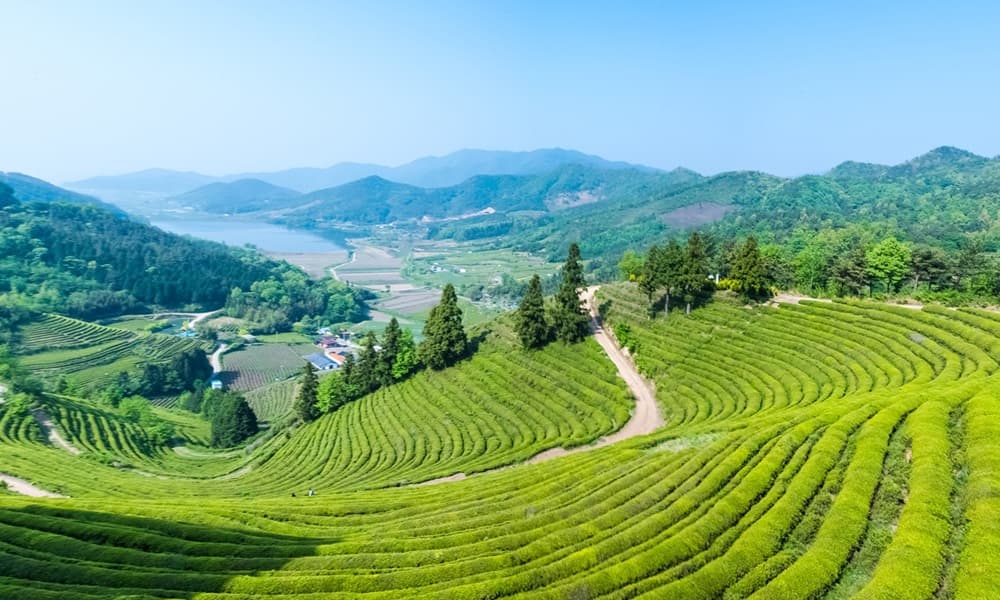
The estate spans 1.7 million m² and is home to more than five million tea plants, cultivated in terraces. It also hosts other plant species (bamboos, pines, maples, cherry trees) and wildlife—including wild boar and birds. Everything can be admired from the observatory, located at 250 m altitude in the hills (allow approximately 54 minutes of walking to reach it).
The visit
Several trails are accessible to visitors. The main circuit begins with a grand staircase that then gives access to different trails through the heart of the plantations.
At the end of the visit, it's possible to visit the Korea Tea Museum, to learn more about the estate's history, enjoy a tasting, or purchase teas harvested from the estate (powder, leaves, etc.).
The Daehan Dawon plantation also has a restaurant, where you can taste Korean specialties infused with tea.
The festival
Each year, in May (when the tea plantations are at their most verdant), the estate hosts the Boseong Green Tea Festival—one of the country's most significant events.
The event offers a glimpse into daily life at the heart of the plantations, with harvesting demonstrations, workshops, walks, and tea ceremonies. It's also an opportunity to watch a light show in the fields.
Practical information ● Address : 763-43, Nokcha-ro, Boseong-eup, Boseong-gun, Jeollanam-do ● How to get there : easily accessible by train, taxis or bus from Yeosu (and by bus from Seoul) ● Opening hours : daily 9 am to 7 pm (May to August); 9 am to 6 pm (September to April) ● Plantation visit fee: 4,000 ₩ (approximately €3); free for under 6s ● Museum admission: 1,000 ₩ (approximately €1, additional charge). |
Hadong and Jiri Mountain regions
Its history
Tea cultivation in the Hadong region and in the valleys at the foot of Mount Jirisan dates back to the 9th century. It was introduced there by Buddhist monks returning from China. These are the lands where South Korea's oldest wild tea bushes are found. Each year, the Hadong region organizes a wild tea festival.
Its rare ancestral production
Unlike the large-scale, mechanized plantations of Boseong and Jeju: Hadong's harvests are carried out using ancestral techniques. Indeed, producers harvest tea leaves by hand.
They notably produce balhyocha, a rare black tea, from early spring harvests. The Hadong region has more than 1,000 hectares of plantations, supporting over 2,000 farms—generating billions of won annually.
Hadong teas are made in a wok using a method influenced by Chinese tradition (while Boseong and Jeju teas are steam-processed, following Japanese techniques).

The visit
The plantations are particularly concentrated in the small towns of Hwagae-myeon and Akyang-myeon, situated at the foot of Mount Jirisan.
Some farms in the region organize picking sessions, from May to October (approximately 3,000 ₩ per person / €2). Some estates also introduce visitors to tea preparation (fermentation), for approximately 6,000 ₩ per person (€4).
Hadong Wild Tea Museum
To learn more about wild tea production, stop by the Hadong Museum. Located at the foot of Jiri Mountain, it reveals all the secrets of this ancestral production and its roasting processes. An opportunity, too, to purchase a few pouches: these exclusive teas are difficult to find outside the Korean market.
Practical information ● Address : 571-25, Ssanggye-ro, Hadong-gun, Gyeongsangnam-do ● Opening hours : daily 9 am to 6 pm (March to October), 9 am to 5 pm (November to February) ● Admission : free |
Jeju Province
Its history
The island of Jeju is also one of South Korea's main tea production areas. Although exploitation there is more recent (it developed in the early 1970s), Jeju is now home to several large mechanized plantations—notably O'sulloc: one of the country's leading producers.
Founded in 1079, O'sulloc is far more than a simple producer, but a symbol of the country's economic renaissance. The brand offers a wide range of teas and its plantations cover 495,000 m² of land.
The visit
The farm has three main fields: Dolsongi, Seogwang and Hannam. Visitors can roam freely through the Seogwang Tea Garden plantations. The site also has its own museum and O'sulloc tea shop. The farm regularly organizes workshops and tastings.

Practical information
● Address : Osulloc Tea Museum, 15 Sinhwayeoksa-ro, Andeok-myeon, Seogwipo-si, Jeju-do ● Opening hours : daily 9 am to 6 pm (closes at 5 pm in winter) ● Admission : free |
Note that there is also the smaller, quieter family-run Seogwi Dawon tea farm...
Address : 516-717, Seogwipo-si, Jeju-do
Tea culture in South Korea: its history and production
An ancestral history, between rituals and modernity
According to ancient texts, tea consumption in South Korea dates back to 661. But it was under the Silla dynasty (668-935 CE) that it took off, in the context of Buddhist rituals. Later, under the Goryeo dynasty, tea entered the homes of Korean aristocracy and continued its rise (with the expansion of Buddhism).
By the end of the Goryeo dynasty reign, in 1932, interest in tea waned before regaining momentum in the 1980s, as Koreans immersed themselves in their ancestral traditions and customs. This renewed interest was accompanied by a desire to industrialize the tea sector.
Unfortunately, this momentum was halted in 2007 by a crisis related to excessive pesticide use, which greatly damaged the reputation of Korean teas... The upside? The sector questioned itself and came back strong with more sustainable practices and organic plantations!
Since then, Korean tea has gained international visibility with, paradoxically, little export, as production remains quite limited and 40% of output is destined for domestic consumption.
On the Korean market, local tea is nonetheless a fine alternative to Japanese tea, with equivalent quality and more competitive prices…
Seasonality and harvesting methods
When visiting a plantation, it's possible to purchase teas harvested from the estate. It's therefore useful to know the characteristics of each tea and their differences to make the best choice…Don't hesitate to do several tastings on site, and take home different types of tea.
Tea classification is based on its harvest period, but also on its oxidation time, which affects its flavor.
Based on harvest date
Woojeon tea : hand-picked around April 20, it is made from tender buds. This type of tea is produced in very small quantities and is quite expensive.
Sejak tea : also made from buds, it is harvested a bit later, in early May, remaining young and fresh. It is the most popular green tea in South Korea.
Joongjak tea : picked after May 5, at a more advanced stage of development, this tea is made from more open leaves. It has a more pronounced flavor.
Daejak tea : made with very mature leaves, this tea is generally harvested by machine. Its production may also contain stems and small branches, giving it an astringent character.
Based on oxidation time
After harvesting, tea leaves begin to oxidize when exposed to air. This natural process changes their color and aromas. The longer the oxidation period, the more pronounced the tea's flavor becomes.
White tea : little or not oxidized, white tea is consumed shortly after harvest. It has a subtle, light taste. Except in a few plantations in the Hadong region, white tea production is very rare in South Korea.
Wulong (or oolong) tea : this green tea is often called "blue tea" because of the color of its semi-oxidized leaves in open air (between 30% and 70% oxidation). It presents a fairly complex aromatic palette.
Black tea: heavily oxidized (between 80 and 100%), black tea is very strong on the palate. It is a premium tea, consumed on special occasions, like Jukro (prized for its cocoa notes and intensity). Black tea production in South Korea is very limited.
Balhyocha tea : this is an atypical fermented tea and difficult to categorize. With intermediate oxidation, it is essentially cultivated in Hadong and is recognized for its region's characteristic, intense and woody aromas.
Frequently asked questions
How can I get to Boseong to visit a tea plantation?
The Daehan Dawon tea plantation is accessible from Seoul (approximately 3 hours 20 minutes by bus from the Central City Terminal to Gwangju + 2 hours by intercity bus to Boseong + 15-20 minutes by local bus to the plantation). It is also possible to get there from Suncheon (approximately 1 hour by Intercity bus to Boseong + 15-20 minutes by local bus) if you are staying in the South Jeolla region.
What is the name of the most famous tea plantation in South Korea?
South Korea's most famous tea plantation is Daehan Dawon. Founded in the 1930s under Japanese occupation, it now ensures over 40% of national production. Located in Boseong, it is also known for its terraced landscapes, open to visitors.
What type of tea do Koreans drink?
The most consumed tea in South Korea is nokcha, a green tea made from young, unoxidized leaves, that is, consumed shortly after harvest. Unlike "aged" teas, which develop more pronounced aromas: nokcha is appreciated for its lightness and freshness. Koreans also frequently drink bori-cha, an infusion of roasted barley, considered a caffeine-free alternative.
Frequently asked questions
The best time to visit tea plantations in South Korea is spring, between April and May. This is when the tea plants are most verdant and when the year's first harvests take place (including the precious Woojeron tea, picked around April 20). The Boseong Green Tea Festival also takes place in May. The plantations remain accessible through October for tastings and workshops.
A day trip from Seoul to Boseong is possible but ambitious, as the journey takes approximately 3 hours 20 minutes (bus from Central City Terminal to Gwangju, then intercity bus to Boseong). It is preferable to plan at least one night there to fully enjoy the Daehan Dawon plantation and the region.
Boseong and Jeju teas are produced on a large scale mechanically and steam-processed, following techniques of Japanese influence. Hadong teas, on the other hand, are hand-harvested using ancestral methods and made in a wok, following Chinese tradition. This difference in production gives Hadong teas a rarer character and more intense aromas, particularly for balhyocha.
Yes, several farms in the Hadong region offer picking sessions from May to October, starting at approximately 3,000 ₩ (around €2) per person. Some estates also organize workshops introducing visitors to tea preparation and fermentation for approximately 6,000 ₩ (€4). The Daehan Dawon plantation in Boseong also offers tastings and guided tours.
Korean tea is rarely exported and difficult to find outside South Korea, making it a rare and authentic souvenir. The shops at the plantations (such as O'sulloc in Jeju or the Korea Tea Museum in Boseong) offer loose leaf or powdered teas produced on-site. Hadong teas, notably balhyocha, are particularly exclusive and almost impossible to find abroad.